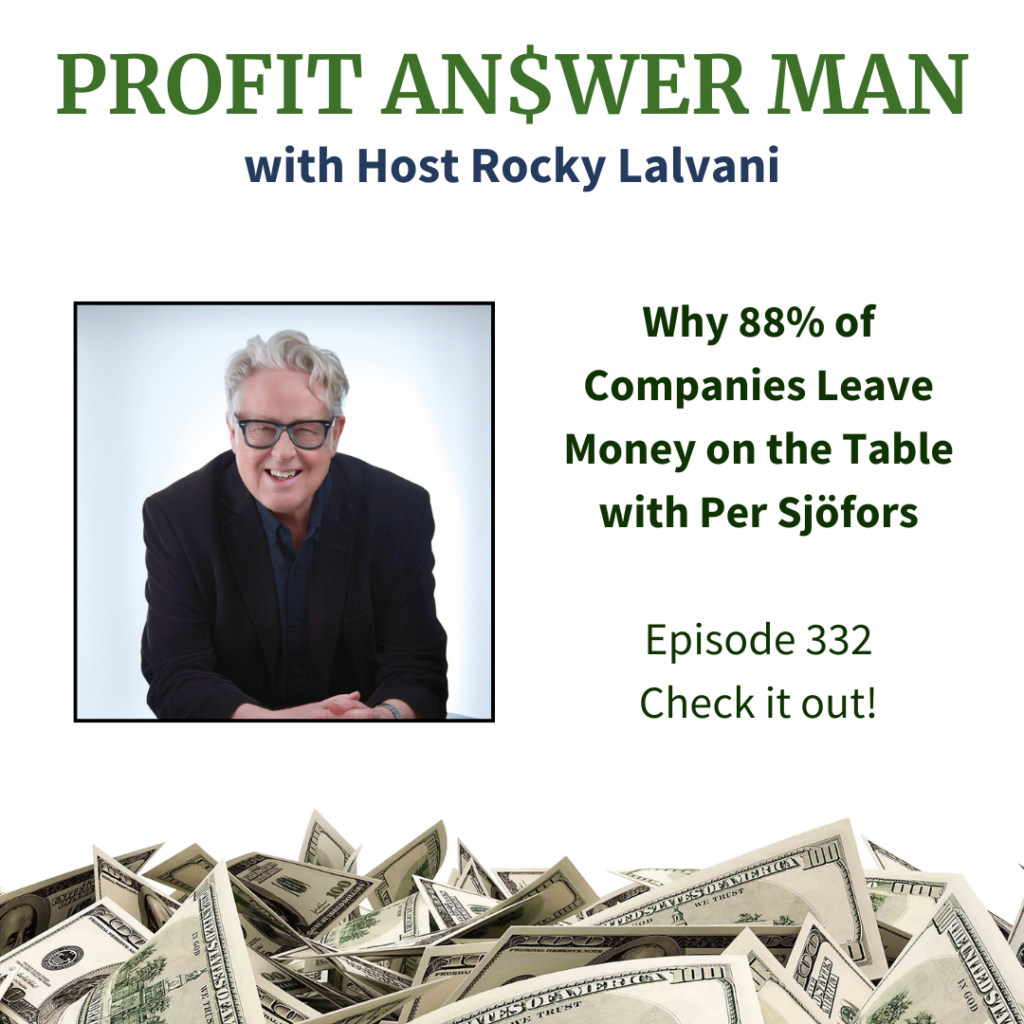
Episode 332 | The Profit Answer Man | Per Sjöfors
You ran the numbers on a price increase once. Maybe more than once. The math worked. A few percent up, and the profit line moved in a way that should have made the decision obvious.
You still didn’t do it.
You are not the only owner who has frozen at that exact spot, calculator open, knowing the answer, and quietly closing the laptop. Per Sjöfors, the pricing strategist known as the Price Whisperer, has watched it happen for years. As he put it on this episode, owners “know intellectually they have to, but behaviorally they’re stuck.” That sentence is the whole problem. And it is not a math problem.
The Number You Already Believe and Still Ignore
Here is the part that should sting a little. The math is not in question. Per pointed to McKinsey research showing that across the global Fortune 500, a one percent price increase produced an eleven point three percent profit improvement. He did not stop at the average. He pulled four small public companies at random and ran the same one percent increase himself. The results: a six percent profit jump for one, sixteen percent for another, and twenty-one percent for two of them.
Rocky put it in the language his audience already uses: for a lot of companies, a ten percent price increase results in a doubling of profit. No new customers. No new market. No new product. Just a number you control, moved a few points in the direction you already know is correct.
So if the math is this clear, why does the trades owner doing $4M still send out quotes at last year’s prices? Because the cost of the gap is invisible. You never see the profit you didn’t capture. It doesn’t show up as a line item called “money I left on the table.” It just shows up as cash that stays tight while you work harder. The structure hides the loss, and an invisible loss is one you never fight.
Of Course You Discount. Everyone Told You To.
It would be easy to call this a discipline problem. It isn’t. You learned to compete the way the whole market taught you to compete. When work gets quiet, you sharpen the pencil. When a sales rep says you’ll lose the job at full price, you believe them, because losing a customer feels like the worst thing that can happen.
That instinct made sense. Every sales conversation, every competitor, every slow month trained you to protect volume. Nobody sat you down and showed you what the discount actually does on the back end. So you did the logical thing with incomplete instruments. The instinct was not wrong. It was just expensive in a way nobody priced out for you.
The Discount Math Nobody Ran for You
Here is the number that reframes everything. Per laid out the inverse of the price-increase math, and it is uglier than most owners expect.
Take a company running an average margin around ten or eleven percent, which describes a lot of trades and distribution businesses. Your salespeople convince you to discount another five percent to close. To net the same dollar profit you had before, you now have to double your sales volume.
Double. Not recover a little. Double the work, double the jobs, double the labor and materials and scheduling and risk, to stand exactly where you were standing before you cut the price. That is what a five percent discount buys you on a thin margin. And it gets handed out in the field every week as if it were free.
This is why Rocky tells owners to pay salespeople on gross profit instead of revenue. When the rep’s pay is tied to margin, cutting price cuts their own check, and suddenly the company and the sales team want the same thing. As Per said, “salespeople should always be paid by margin.” The structure that lets reps trade away your profit to make their quota easier is the villain here. You are the owner trying to grow a business while the incentive system quietly works against you.
The Customer Who Wants the Lowest Price Is Not Your Customer
There is a deeper trap underneath the discount habit. Per named it plainly: the vast majority of companies are so afraid of losing a customer that they let the most price-sensitive buyer set the tone for the whole business.
Flip it. You can trade lower volume for customers with a higher willingness to pay, and then serve those customers far better. Per used his own Apple example. His machines are out of warranty, he never bought the service package, and Apple still puts an expert on a chat window in under thirty seconds and escalates to a phone call if that doesn’t fix it. He pays a massive premium for that ecosystem, and when his MacBook is up for renewal, he is buying another Mac.
Now hold that next to today’s reality, where most companies won’t even answer the phone. As Rocky said, a company that picks up the phone and talks to its customers automatically goes to the top of the line. Excellent service is not a cost. It is a pricing lever. It is the reason a customer pays you fifty percent more and feels good about it.
The car wash story makes the cost of ignoring this concrete. Per described an owner with an old, fine, profitable car wash who didn’t want to raise prices because he was doing okay. Then a fancy membership-model car wash opened nearby and took his customers. He didn’t have the excess cash to rebuild and compete, so he went out of business and couldn’t even sell. He didn’t lose because his prices were too high. He lost because they were too low to ever fund his own future.
The Two-Word Test: Pricing Power
If you want one idea to carry out of this episode, it is a phrase Warren Buffett coined in 2010: pricing power. Buffett told a government panel that his main criterion for where he puts his money is whether a company has pricing power, which he defined as the ability to raise price without losing sales volume. Then he added the line worth taping to your monitor: “if you have to say a prayer before increasing your price with a tenth of a percent, you have a very bad business.”
Most owners pray before every increase. That prayer is the diagnosis. It tells you the business has not been built to support its own prices yet, which is fixable, but only once you stop treating price as a number you defend and start treating it as something you design.
What Rocky Would Say If You Were Across the Table
Here is what I see when I sit down with a $5M trades owner who is busy and still broke. You are not under-selling. You are under-pricing, and the cost of that is not just margin. It is you.
When you raise prices, the first thing the extra money buys is not a bigger truck or a fatter distribution. It is A players. It is the ability to hire people good enough to take the work off your plate, the people who do the right things and don’t need to be managed every hour.
That is how the organization gets lighter. That is how you stop being stuck in the middle of your own business.
Costco pays its people more than other retailers and gets better employees, fewer of them, and less management overhead as a result. You can run the same play at $5M. But you can only afford the A players if your prices fund them. Underpricing doesn’t just cost you profit. It traps you inside the business doing work you should have handed off two hires ago.
The One Thing to Do This Week
Sort your products or services into three buckets: the ones that are genuinely unique, the ones that are pure commodity, and the ones in between. That’s it. Per said this single step, categorizing and then pricing each tier on its own logic, can often double a company’s margin, and almost no company does it.
For the unique work where customers have no real alternative, stop all discounting. For the commodity work, drive cost out, because commodities sell on price alone. For the in-between, look for one way to make it unique enough to earn pricing power. After you do this, you will know exactly where you have been giving away margin out of habit, and exactly where you have permission to charge more starting now.
Back to the Calculator
So go back to the laptop you closed. Open the math you already trust. The reason you froze last time was never the number. It was that nobody had shown you what the discount costs, what the customer who only wants cheap is really worth, and what the extra margin would actually buy you. Now you have a specific first move: three buckets, three pricing strategies, starting this week. The flinch is fixable. The path runs through your own price list.
About Per Sjöfors
Per Sjöfors, also known as The Price Whisperer®, is a distinguished American and Swedish national renowned for his expertise in pricing strategy. He is the best-selling author of “A Holistic Approach to Pricing Power” and serves as a member and thought leader at the Forbes Business Council and the C-Suite Hero Club.
Recently, Per Sjöfors was recognized as one of the “10 Most Visionary Leaders Making a Difference in 2025” by Inc. Magazine and was also named among the “Top 50 Global Thought Leaders in Sales” by Thinkers360. Notably, CEO View Magazine honored his company, Sjofors & Partners, as one of the Top 50 Most Innovative Companies in 2025.
As a prominent public figure, Per Sjöfors frequently appears on podcasts and business radio shows, often providing insightful commentary and quotes in the press. His expertise is widely recognized by publications such as Forbes, Fortune Magazine, Inc. Magazine, Industry Week, Business Insider, and the Financial Times.
Per Sjöfors’s teaching philosophy centers around empowering executives to propel their companies forward through the application of behavioral science specifically tailored to pricing and go-to-market strategies. His company, Sjofors & Partners, offers intensely practical advice that consistently leads to a doubling of sales growth and a 25% to 40% increase in margins. By providing the necessary growth resources, Per Sjöfors enables companies to reach new heights.
Prior to founding Sjofors & Partners, Per Sjöfors dedicated 35 years to executive management, primarily as CEO. During his tenure, he successfully grew companies from inception to eight- and nine-figure revenue in four countries (the United States, the United Kingdom, Switzerland, and Sweden). Additionally, he organized joint venture firms in three other countries (Japan, Taiwan, and Korea) and engaged in business operations across more than forty nations. Further details can be found on their website at https://sjofors.com.
Links
Previous Ep 137 The Price Whisperer, A Holistic Approach to Pricing Power with Per Sjöfors: https://youtu.be/Wvkaslsnepo
Profit Blueprint Calculator | Profit Comes First: https://lp.profitcomesfirst.com/profitblueprintcalc-page
Watch the full episode on YouTube: https://www.youtube.com/@profitanswerman
Sign up to be notified when the next cohort of the Profit First Experience Course is available!
Free Copy of the Profit Blueprint Book: https://lp.profitcomesfirst.com/landing-page-page
Monthly Newsletter signup: https://lp.profitcomesfirst.com/newsletter-signup
Relay Bank (affiliate link): https://relayfi.com/?referralcode=profitcomesfirst
Profit Answer Man Facebook group: https://www.facebook.com/groups/profitanswerman/
My podcast about living a richer more meaningful life: http://richersoul.com/
Music provided by Junan from Junan Podcast
Any financial advice is for educational purposes only and you should consult with an expert for your specific needs.