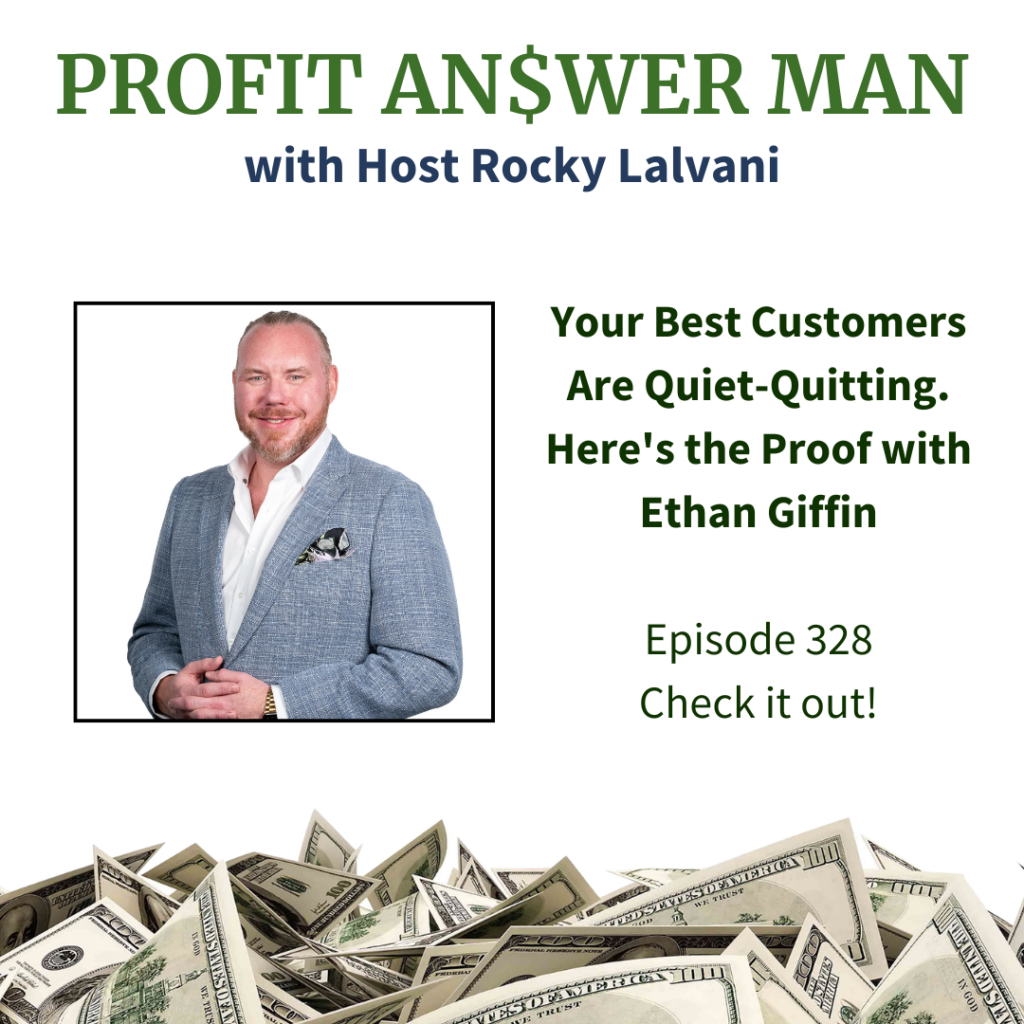
Episode 328 | The Profit Answer Man I Ethan Giffin
The account manager mentioned it on a Tuesday call. Not as a problem. As a data point.
One of your top ten accounts, a regional contractor who had bought from you for nine years, had gone from 14 orders a month to four. Same account. Same rep. Same pricing. Just fewer orders, with no explanation and no conversation that prompted the change.
Nobody canceled. Nobody complained. The customer still picks up when the rep calls. But somewhere in the last 18 months the recurring stuff, the consumables, the orders that were supposed to be automatic, started going elsewhere. Not because your product got worse. Because buying from someone else got easier.
If you run a manufacturing or distribution business, you have a version of this account. You may not have pulled the data to prove it yet. But it’s in there.
Ethan Giffin has a name for it. He calls it B2B quiet quitting. On a recent Profit Answer Man episode, he laid out how to find it, what it costs per order, and why most companies that try to fix it blow it before they start.
The Proof Is in Order Frequency, Not Revenue
Quiet quitting is hard to catch early because it doesn’t show up where owners look. Revenue from an account can hold steady or even tick up while reorder frequency falls, because the customer keeps the big, hard-to-replace orders with you and quietly moves the easy recurring items to whoever gave them a self-service option.
The test is simple. Pull your top 20 accounts. Look at order frequency over the last 24 months, not total revenue. If a handful have slipped from weekly to monthly with no conversation explaining it, you’re reading the early data of quiet quitting. The revenue line hasn’t caught up. The frequency line already has.
For a $30M distributor, one account sliding from 14 orders a month to four is not a crisis. Multiply that across six accounts and you’ve lost the equivalent of a mid-size customer without a single cancellation.
The $45 Per Order Hiding in Normal Operations
There’s a structural reason your customers are drifting, and it lives inside what you’ve always called normal operations.
Every order through your call center costs roughly $50 to process by the time everyone touches it: the rep who takes the call, the data entry, the pricing confirmation, the inventory check, the handoff to fulfillment. The same order through a self-service portal costs roughly $5.
That $45 gap appears nowhere in your P&L with a label. It’s spread across headcount you’ve normalized, wages you’ve chalked up to growth, and overhead you stopped questioning because the orders kept coming. The math, though, is not complicated.
Process 2,000 orders a month with 60% through the call center, and that’s 1,200 orders at $50 each. $720,000 a year on processing that could cost $72,000. A $648,000 gap is not a rounding error. It’s a structural drain sitting in plain sight inside the cost of doing business. [LINK TO: profit blueprint]
And here’s the second half. Every time you grow, you add people to handle more calls. The call center gets bigger, the overhead scales with revenue, the margin stays flat. That’s not a growth business. That’s a treadmill with a bigger motor.
Of course, You didn’t Build a Portal. Nobody Ran the Number.
Most manufacturers and distributors in the $5M to $100M range haven’t modernized their buying experience, and it’s not ignorance. It’s rational prioritization on incomplete information.
Revenue grew. You hired to handle volume. The call center scaled. Every time a digital project came up, sales said customers wouldn’t use it, IT said the ERP integration would take two years, and finance said the budget wasn’t there. None of those objections were wrong. They were answers to the wrong question.
The question nobody asked: what is it costing us, per order, to keep doing it this way? With no one running that number, the status quo had no price tag. And a project with real cost always loses to a status quo that feels free.
Meanwhile, the people entering your customers’ procurement departments have never placed a fax order and never will. The 28-year-old purchasing manager at your largest account has ordered everything in his life through apps since college. He won’t ask you to modernize. He’ll find someone who already did.
The Sales Objection Has a Specific Answer
Here’s the objection that kills these projects before a platform is even evaluated: the sales team will feel threatened.
Ethan hears it in nearly every engagement. His answer is specific, not reassuring.
When customers self-serve repeat orders, salespeople don’t lose commission. They get higher quotas, because the company can finally afford to have them selling instead of entering orders. Territory expands because the management burden per account drops. The rep fielding 40 reorder calls a day suddenly has room to work the long-tail accounts nobody has ever really talked to.
The unlock is one policy: reps get full credit for everything their customers order online, exactly as if it came by phone. Communicated clearly before launch, that decides whether sales builds adoption or quietly buries it. Companies that failed at digital almost always skipped that conversation. The technology was fine. The alignment wasn’t there.
The Heroes Who Are Protecting the Problem
Almost every company past 20 years old has this person: there since the beginning, processes a complex order in four minutes while handling a complaint on the other line, celebrated internally as the one who keeps things running.
Rocky calls this person the arsonist. Not out of malice. Because the friction they heroically overcome has survived precisely because their heroism made it survivable. Their indispensability is a function of the system’s dysfunction. You stopped fixing the process because they made the broken one work.
When Ethan gets a leadership team into a discovery session, heads of sales, ops, marketing, finance, and IT in one room, it’s often the 20-year customer service veteran who starts listing the problems. Not to expose anything. Because she has lived them so long they feel normal. The CEO, who hasn’t been near the order process in years, hears his own customer experience described from the inside for the first time.
That room is where the real project begins. Not with a platform. With an honest account of what it’s like to buy from you.
What Rocky Sees Across From a $40M Distributor
Here’s what I find in these businesses almost every time. The cost structure scaled with revenue, but the wrong costs scaled. The call center grew. The number of hands on each order grew. The admin overhead grew. And the margin stayed flat or shrank while the top line climbed.
Revenue growth that needs proportional headcount is not scalable. It’s a ceiling with a moving floor. At some point, earlier than most owners expect, you can’t throw more people at the order process. You max out the call center, the patience of the reps, and the tolerance of customers quietly calculating whether buying from you is still worth the friction.
The fix is not a technology project. It’s a systems and alignment project that happens to end in a technology decision. Sequence beats platform. Pick the tech first and you get a portal sales undermines, customers distrust, and IT can’t support. Do the alignment work first and the technology nearly chooses itself.
The One Thing to Do This Week
Pull your last 12 months of order data. Take your top 20 accounts by revenue. For each, compare average monthly order frequency in the first half of the year against the second half. You’re hunting for accounts where frequency fell with no conversation to explain it.
That’s your proof. Not a hypothesis, not a trend piece. Your own data, from your own ERP, showing which relationships are quiet-quitting right now.
With that list, you have something concrete for your sales team, your ops team, and your CFO. Not a pitch for a digital project. A diagnosis. The project comes after. Every attempt to start with the project ends with an unused portal and a demoralized team.
Diagnosis before prescription. It’s the only sequence that works.
The customers who are quiet-quitting won’t announce it. They’ll keep the account open, keep taking the rep’s calls, and keep moving their easy orders elsewhere, one reorder at a time, until the frequency data tells a story you can’t ignore.
You now know how to read that story before it’s finished. The only question is whether you pull the data this week or wait for the revenue chart to do it for you.
About Ethan Giffin
Ethan Giffin is the Founder and CEO of The B2B eCommerce Agency and author of Closing the Digital Revenue Gap. Since 2007, he has worked with mid-market manufacturers and distributors across the U.S., helping executive teams find the structural leaks in their revenue, modernize how their customers buy, and build digital systems that actually get used. He also hosts The B2B eCommerce Summit, an annual gathering of operators shaping the future of B2B commerce.
Ethan’s approach focuses on three things most digital projects skip: sequence, alignment, and adoption. His book and consulting work give executive teams a practical blueprint to protect margins and build buying experiences that keep customers coming back. Away from the agency, he performs as DJ Opie, producing nonprofit galas across Baltimore since the age of 16, helping charitable organizations create events that raise more money and leave a lasting impression on donors.
Links
Website: https://ethangiffin.com/
https://b2becommerceagency.com/
LinkedIn: https://www.linkedin.com/in/ethangiffin/
https://www.linkedin.com/company/b2becommerceagency/
YouTube: https://www.youtube.com/@B2BeCommerceAgency
Podcast: TheB2BeCommercePodcast
Free Copy of the book: https://b2becommerceagency.com/free-consultation/
Profit Blueprint Calculator I Profit Comes First: https://lp.profitcomesfirst.com/profitblueprintcalc-page
Watch the full episode on YouTube: https://www.youtube.com/@profitanswerman
Sign up to be notified when the next cohort of the Profit First Experience Course is available!
Free Copy of the Profit Blueprint Book: https://lp.profitcomesfirst.com/landing-page-page
Monthly Newsletter signup: https://lp.profitcomesfirst.com/newsletter-signup
Relay Bank (affiliate link): https://relayfi.com/?referralcode=profitcomesfirst
Profit Answer Man Facebook group: https://www.facebook.com/groups/profitanswerman/
My podcast about living a richer more meaningful life: http://richersoul.com/
Music provided by Junan from Junan Podcast
Any financial advice is for educational purposes only and you should consult with an expert for your specific needs.