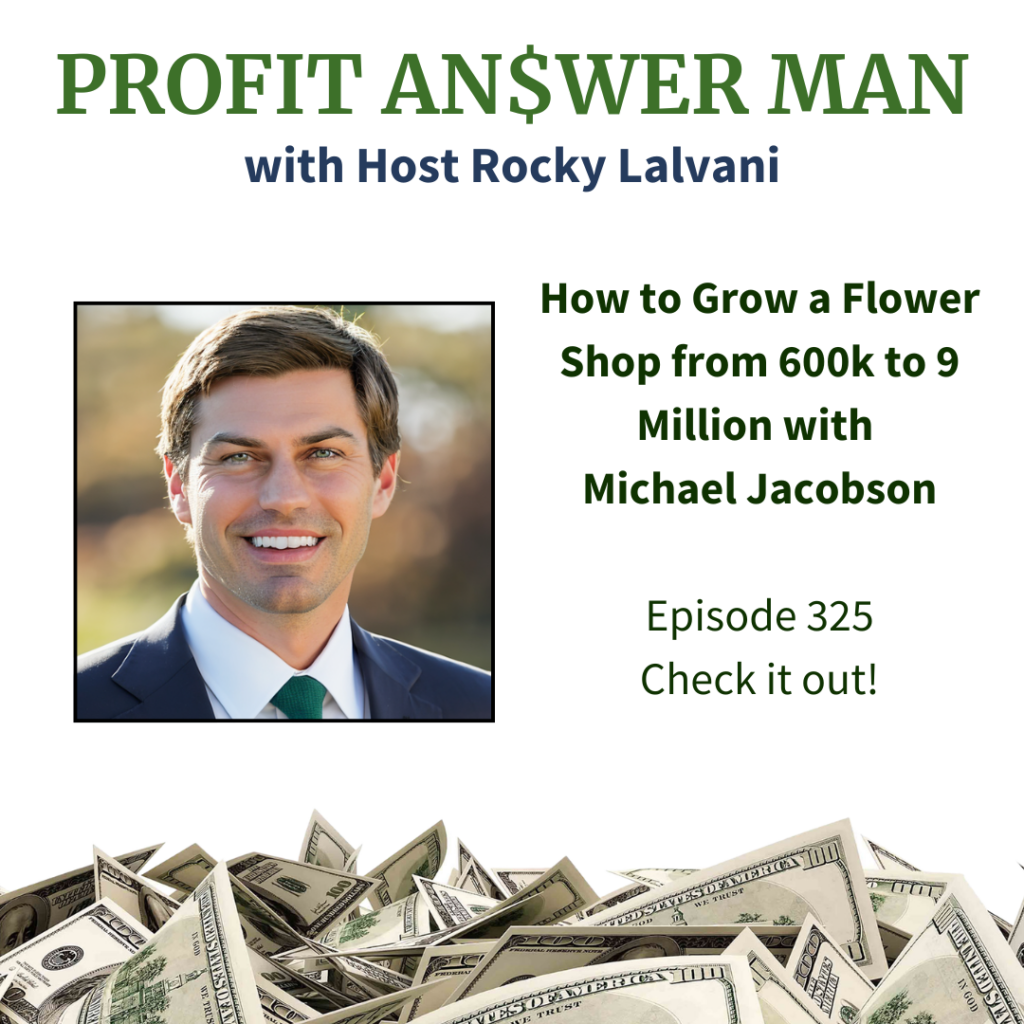
Episode 325 | The Profit Answer Man I Featuring Michael Jacobson
Stop Guessing and Use Data to Protect Profit
Most small business owners do not have a revenue problem. They have a visibility problem.
They are working hard, selling more, hiring more, and carrying more responsibility than ever. But their cash flow does not reflect the effort. Their margins stay tight. Their take-home pay feels smaller than it should. And too often, the answer they hear is simple: grow more.
That is exactly the kind of thinking Rocky Lalvani pushes back on.
In this episode of Profit Answer Man, Rocky talks with Michael Jacobson about how he turned a struggling flower shop into a growing multi-location business. On the surface, the floral industry may sound very different from other businesses. But the lessons are universal for any owner dealing with waste, thin margins, messy operations, and the constant pressure to grow. This conversation is really about profit first, cash flow, and building systems that make business profit possible. It is not about doing more. It is about doing better.
From Failing Business to Scalable Operation
Michael Jacobson did not start in flowers. He came from finance and corporate consulting, then took a very different path into entrepreneurship. Instead of launching a startup from scratch, he bought his uncle’s struggling flower shop. At the time, the business was losing money and was not really in condition to sell.
That alone is an important lesson for business owners.
A lot of people think opportunity shows up in polished form. It usually does not. More often, opportunity shows up looking messy, inefficient, and overlooked. Michael saw that the flower shop itself was only part of the opportunity. The larger opportunity was the industry around it. It was fragmented, operationally weak, and full of pain points.
And where there is pain, there is often margin.
That mindset matters whether you run a service company, a manufacturer, a retail business, or a trades business. If you can identify what most people in your industry simply accept as “the way it is,” you may be looking at the exact place where profit is hiding.
Waste Is Quietly Killing Your Profit
One of Rocky’s strongest contributions in this conversation was his focus on waste. He made the point that every business has it, and most owners do not understand how badly it hits margins.
He is right.
Waste does not always look dramatic. Sometimes it is spoiled product. Sometimes it is labor that is poorly deployed. Sometimes it is unnecessary process, overbuying, rework, or lack of planning. In service businesses, it can show up as unbilled hours, bad handoffs, poor scheduling, or staff spending time on low-value tasks. In product businesses, it may appear in inventory, setup losses, fulfillment mistakes, or purchasing decisions made with weak forecasting.
In Michael’s case, perishability made the waste impossible to ignore. Flowers do not sit around forever. If the buying is wrong, the margin is gone. But the bigger lesson is not about flowers. The bigger lesson is that business owners need to stop relying on instinct alone and start building systems that show them where waste lives.
Gut instinct matters. But instinct without data is expensive.
That is one reason this episode is so useful for owners trying to improve small business finances. If you do not measure waste, you cannot manage it. And if you cannot manage it, your profit margin will always be lower than it should be.
Better Data Creates Better Decisions
Michael did not solve the problem by working harder. He solved it by building better systems.
He explained that one of the major shifts in the business came from combining supply chain changes with technology. The company created digital inventory systems, used iPads for designers, and built predictive analytics that could forecast what flowers were needed for specific dates. The system could compare what it predicted against what was actually used and improve over time.
That is a powerful idea for any business owner.
The goal of data is not to create more reports. The goal is to make better decisions sooner.
Too many owners have numbers, but not decision-grade information. They get a P&L after the month is over. They look at high-level revenue. They see payroll totals. But they do not see the patterns that actually drive cash flow. They do not know which product lines create the best margin, where labor is underperforming, or where inventory assumptions are wrong.
Michael’s example shows what happens when data becomes operational. It starts helping the business before the money is already gone.
This is where profit first thinking becomes practical. Profit first is not just about bank accounts or allocations. It is about building a business that generates predictable cash because the underlying decisions are stronger. Better forecasting, better purchasing, better productivity, and better constraints all support healthier cash flow.
Owners who want more financial freedom should be asking a simple question: what am I still guessing at that I should be measuring?
Guardrails Do Not Kill Creativity
A lot of owners resist structure because they think structure kills creativity. Michael argued the opposite.
He said some of the best creative work happens when guardrails are in place.
That is not just a creative-business lesson. It is a leadership lesson.
People do better work when they understand the boundaries. A budget, a target margin, a production standard, a timeline, or a service-level expectation does not automatically limit performance. Often it improves it. Constraints force clarity. They push teams to make stronger choices instead of unlimited ones.
Michael described how design teams could work within specific cost parameters and still create excellent outcomes. That improved profitability without stripping away good work. The business also used system-based recipes and productivity tracking, not to micromanage, but to create visibility and accountability.
That should resonate with any owner who feels trapped between two bad choices: total freedom or suffocating control.
There is a better path. Set clear principles. Define the economics. Create the rules of the game. Then give good people room to operate inside them.
That is how you scale without chaos.
Hire People Who Outperform You
One of the strongest ideas in the episode was Michael’s view on hiring. He challenged the mindset that owners should settle for people who operate at a fraction of their own ability. Instead, he said the greatest leverage point he has seen is hiring really smart people and paying them more than he pays himself.
That is a hard truth for many business owners.
A lot of founders want growth, but they still want to be the smartest, highest-paid, most essential person in the room. That approach does not scale. It creates dependency, bottlenecks, and exhaustion. The business ends up organized around the owner’s availability instead of around a real operating system.
Michael’s approach is different. He wants specialists who are better than him in their seats. Better managers. Better operators. Better creatives. Better functional leaders.
That is how the owner stops being the engine and starts becoming the leverage point.
Rocky’s audience needs to hear that. If your business depends on you to do everything well, then you do not own a scalable company yet. You own a demanding job. And while that may produce some revenue, it rarely creates the kind of business profit, free cash flow, and freedom most owners actually want.
Hiring stronger people is not a cost problem. It is usually a growth strategy.
Growth Mode vs Profitability Mode
Another useful distinction in the conversation was the difference between growth mode and profitability mode. Michael talked openly about reinvesting heavily into the business instead of maximizing short-term personal income.
That does not mean every owner should do the same thing.
What it does mean is that owners need to be intentional. If you are in growth mode, say so. Know why. Know what the payoff should be. Know how long you are willing to stay there. If you are in profitability mode, then your systems, pricing, spending, and hiring all need to support that goal.
Too many businesses live in an unhealthy middle ground. They do not produce enough profit to feel secure, but they also are not making disciplined investments that lead to meaningful scale. They are just busy.
That is why the conversation matters. It reminds owners that financial strategy is about tradeoffs. Growth is not always the answer. More revenue is not automatically better. The right answer depends on what creates durable cash flow and long-term value.
Rocky’s Perspective
What I liked about this conversation is that it shows exactly why more revenue is not the answer by itself.
Michael did not scale by hoping things would improve. He scaled by getting honest about waste, building systems, and making better decisions with data. That is what I see in so many businesses. The opportunity is already there, but the owner cannot see it because the business is too noisy.
If your margins feel tight, do not start by asking how to sell more. Start by asking where profit is leaking out right now. Look at the waste. Look at the labor. Look at the decisions you are making without enough visibility. That is where hidden profit usually lives.
Action Step
Pick one area of your business where you are still relying too much on instinct. It might be inventory, labor efficiency, scheduling, pricing, or fulfillment. Then identify one metric you can start tracking weekly that would make that area more visible. Do not overcomplicate it. Just start measuring something that matters.
Conclusion
This episode is not really about flowers. It is about the discipline required to build a profitable business in the real world. Michael Jacobson’s story shows that when you combine better systems, stronger people, and clear financial thinking, even a messy business can become a scalable one.
About Michael Jacobson
Michael Jacobson didn’t walk into a flower shop expecting anything. It was a favor, helping his uncle sell a business most people would’ve driven past without noticing. The kind of place with dusty corners, a poorly-lit sign, and just enough life left to survive. For Michael, standing there, looking around, it sank in.
This was how America gave flowers now. Flowers were rushed, impersonal, and often treated as just a transaction. No ritual. Just product moving through a pipeline. And yet, this was how people were trying to say “I love you.” “I miss you.” “I’m sorry.” The most emotional gesture in human history had been flattened into a transaction. And no one seemed to notice.
It began with a refusal to accept that this was good enough for flowers. He stripped the entire system to its studs and rethought everything. Every process, every touchpoint. He built a new system from scratch.. One that cut out the noise. One that honored the hands, the farms, the designers, the clients giving and receiving. Because when people send flowers, they are trusting us with their heart. And that should never be taken lightly.
To Michael there’s a permanence in flowers that goes much beyond how long they last. The blooms eventually experience their circle of life, but the feeling stays. The moment they carry becomes part of us.
Inspired by the European tradition of living with flowers daily, Michael wants to shift how Americans see them—not as a luxury, but as an essential meaning they bring to life. Flowers are love, and they are how we know that life can be beautiful. Everyone deserves to feel that.
Today, French Florist has grown from a quiet neighborhood shop into a rising national brand, expanding across the country. But to Michael, scale was never the point. The point was to protect a standard.
In a culture addicted to efficiency, French Florist is building something a little more human. Every stem is placed with intention. Every arrangement is an offering. Every delivery is a quiet rebellion against the idea that love and beauty are optional.
For Michael, it’s always been about the flowers.
And through them, a more loving world.
Links
www.frenchfloristfranchise.com
Profit Blueprint Calculator I Profit Comes First: https://lp.profitcomesfirst.com/profitblueprintcalc-page
Watch the full episode on YouTube: https://www.youtube.com/@profitanswerman
Sign up to be notified when the next cohort of the Profit First Experience Course is available!
Free Copy of the Profit Blueprint Book: https://lp.profitcomesfirst.com/landing-page-page
Monthly Newsletter signup: https://lp.profitcomesfirst.com/newsletter-signup
Relay Bank (affiliate link): https://relayfi.com/?referralcode=profitcomesfirst
Profit Answer Man Facebook group: https://www.facebook.com/groups/profitanswerman/
My podcast about living a richer more meaningful life: http://richersoul.com/
Music provided by Junan from Junan Podcast
Any financial advice is for educational purposes only and you should consult with an expert for your specific needs.