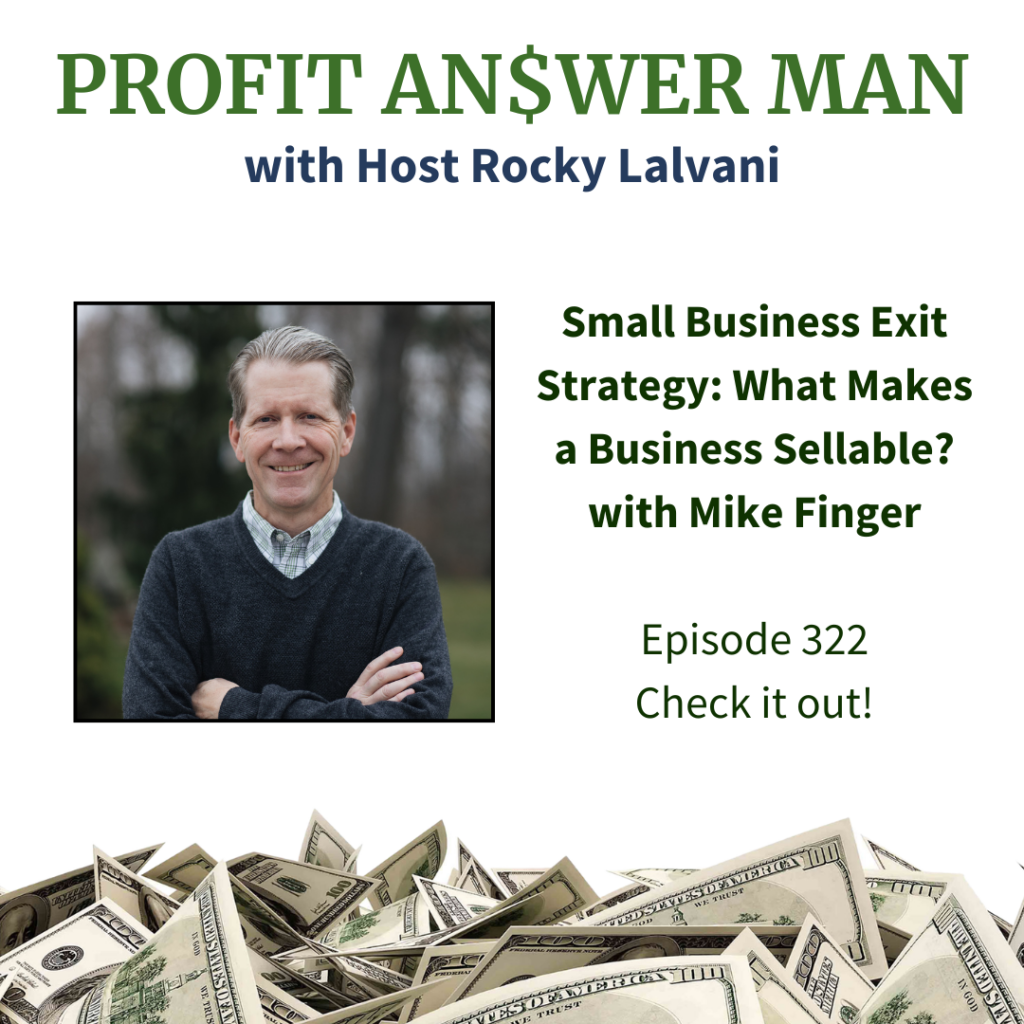
Episode 322 | The Profit Answer Man I Featuring Mike Finger
Unapologetically Small: Building a Business You Can Own and Sell
For the vast majority of entrepreneurs, the ultimate dream is the exit. We envision a day when we hand over the keys to a thriving enterprise, receive a massive check, and sail off into a comfortable retirement. But the reality of small business transitions is far less glamorous and significantly more complex.
On a recent episode of The Profit Answer Man podcast, we sat down with Mike Finger, founder of Exit Oasis. Mike is what he calls “unapologetically small business.” Having bought, built, and sold multiple companies over the last 25 years, he understands the unique hurdles faced by everyday entrepreneurs. His insights challenge conventional wisdom, particularly for the 98% of small businesses operating with fewer than 20 employees.
The 98% of Small Businesses
When you read articles about mergers, acquisitions, and massive multiples, you are usually reading about the top 2% of businesses. The mainstream financial press focuses on tech startups and massive corporations. But what about the local landscaping company, the mid-sized accounting firm, or the regional manufacturing shop?
Mike Finger focuses exclusively on this 98%. These businesses are the backbone of the economy, yet they are notoriously difficult to sell. Mike himself learned this the hard way. Ten years into his first business, with 50 employees relying on him, he discovered his company was entirely unsellable. It was a devastating realization. The business was too dependent on his daily involvement. If he left, the value vanished.
Ownability vs. Sellability
The turning point for Mike came when he realized a profound truth: ownability and sellability are the exact same thing.
Think about it. A business that is stressful to run, highly dependent on the founder, and chaotic in its operations is not a business you enjoy owning. Consequently, it is not a business anyone else wants to buy. Conversely, a business that operates smoothly, generates consistent cash flow, and affords the owner personal freedom is a joy to own—and it’s highly attractive to potential acquirers. As Mike puts it, “Sellability and ownability are next-door neighbors.”
The Three Pillars: Desirable, Duplicatable, Documented
To bridge the gap between a stressful job and a sellable asset, your business must rest on three critical pillars.
First, the results must be desirable. The business must generate real, provable profit. A buyer is not purchasing your hard work; they are purchasing a future stream of cash flow.
Second, the results must be duplicatable. If your personal charm and unique relationships are the only things keeping clients around, a buyer cannot duplicate that success. The business must be able to perform its core functions regardless of who occupies the owner’s chair.
Third, the processes must be documented. You cannot transfer tacit knowledge easily. Standard operating procedures, clean financials, and organized systems prove to a buyer that the engine will keep running once they take over.
The Danger of Chasing Revenue Without Profit
A common trap for small business owners is the relentless pursuit of top-line revenue. We are conditioned to believe that bigger is always better. However, revenue without profit is merely vanity.
Scaling a broken business model only scales your headaches. If you double your revenue but your margins shrink and your stress quadruples, you have not built transferable value. Buyers look at the bottom line. They evaluate the health of the cash flow, not just the volume of transactions. Prioritizing profit ensures that the business is fundamentally sound and worth acquiring.
The Tax/Valuation Tradeoff
One of the most eye-opening concepts Mike discusses is the brutal math of the tax and valuation tradeoff. Small business owners hate paying taxes, often going to great lengths to hide profits, write off personal expenses, and depress their taxable income.
While this might save you a few dollars in April, it devastates your valuation when it is time to sell. Business valuations are typically based on a multiple of your profit. If you hide $100,000 of profit to save $25,000 in taxes, and your business is valued at a 3x multiple, you just cost yourself $300,000 in sale price. To achieve a premium exit, you must show the profit and pay the tax. Clean, provable financials are the bedrock of a successful sale.
The Retirement and Exit Reality Gap
The “silver tsunami”—the predicted massive wave of baby boomer business exits—is a narrative that Mike challenges. He notes that this expected flood of transactions simply hasn’t materialized in the data.
Why? Because of the massive gap between what owners expect their business to sell for and its actual market value. Many owners expect the sale of their business to fully fund their retirement, but too few actually sell successfully. An owner pulling $200,000 a year out of a business might find it only sells for $500,000. That half-million dollars, once invested, will not replace their $200,000 lifestyle. Recognizing this gap early allows you to plan accordingly, either by growing the value of the business or saving aggressively outside of it.
Implementing Systems: Profit First and EOS
To achieve desirability, duplicatability, and documentation, systems are non-negotiable. Mike emphasizes that you don’t need to follow any one system with religious fervor, but you must believe in something.
Frameworks like Profit First help ensure you are prioritizing cash flow and building a provably profitable model. Operational systems like EOS (Entrepreneurial Operating System) help document processes, clarify roles, and remove the owner as the central bottleneck. Find the systems that work for your team and implement them consistently.
The Challenge for You
Building a business you can own and sell doesn’t happen by accident. It requires intentionality. So, here is the challenge: Look at your business today. If you were forced to step away for six months, would the business survive? Would the profits remain stable?
If the answer is no, it’s time to stop working in your business and start working on it. Document your processes, prioritize your profit, and build a machine that serves you—whether you decide to own it forever or sell it tomorrow.
About Mike Finger
Mike Finger is “unapologetically small business”. Over the last 25 years Mike has bought, built and sold multiple businesses. Building his first business was a rewarding challenge, but what really captivated him was selling his first business.
“Selling that business was a miracle in my life. It changed everything, but it almost didn’t happen.”
He was 10 years in with 50 employees when he found out his business was unsellable. It was devastating. But he moved forward and focused on changing a few simple elements in the business. Those changes made that first sale possible, and it changed his life.
He wants to help other small business owners make their business ready, so they can experience the incredible impact of a small business sale.
Links
Website: https://exitoasis.com/
LinkedIn: https://www.linkedin.com/in/mike-finger/
Profit Blueprint Calculator I Profit Comes First: https://lp.profitcomesfirst.com/profitblueprintcalc-page
Watch the full episode on YouTube: https://www.youtube.com/@profitanswerman
Sign up to be notified when the next cohort of the Profit First Experience Course is available!
Free Copy of the Profit Blueprint Book: https://lp.profitcomesfirst.com/landing-page-page
Monthly Newsletter signup: https://lp.profitcomesfirst.com/newsletter-signup
Relay Bank (affiliate link): https://relayfi.com/?referralcode=profitcomesfirst
Profit Answer Man Facebook group: https://www.facebook.com/groups/profitanswerman/
My podcast about living a richer more meaningful life: http://richersoul.com/
Music provided by Junan from Junan Podcast
Any financial advice is for educational purposes only and you should consult with an expert for your specific needs.