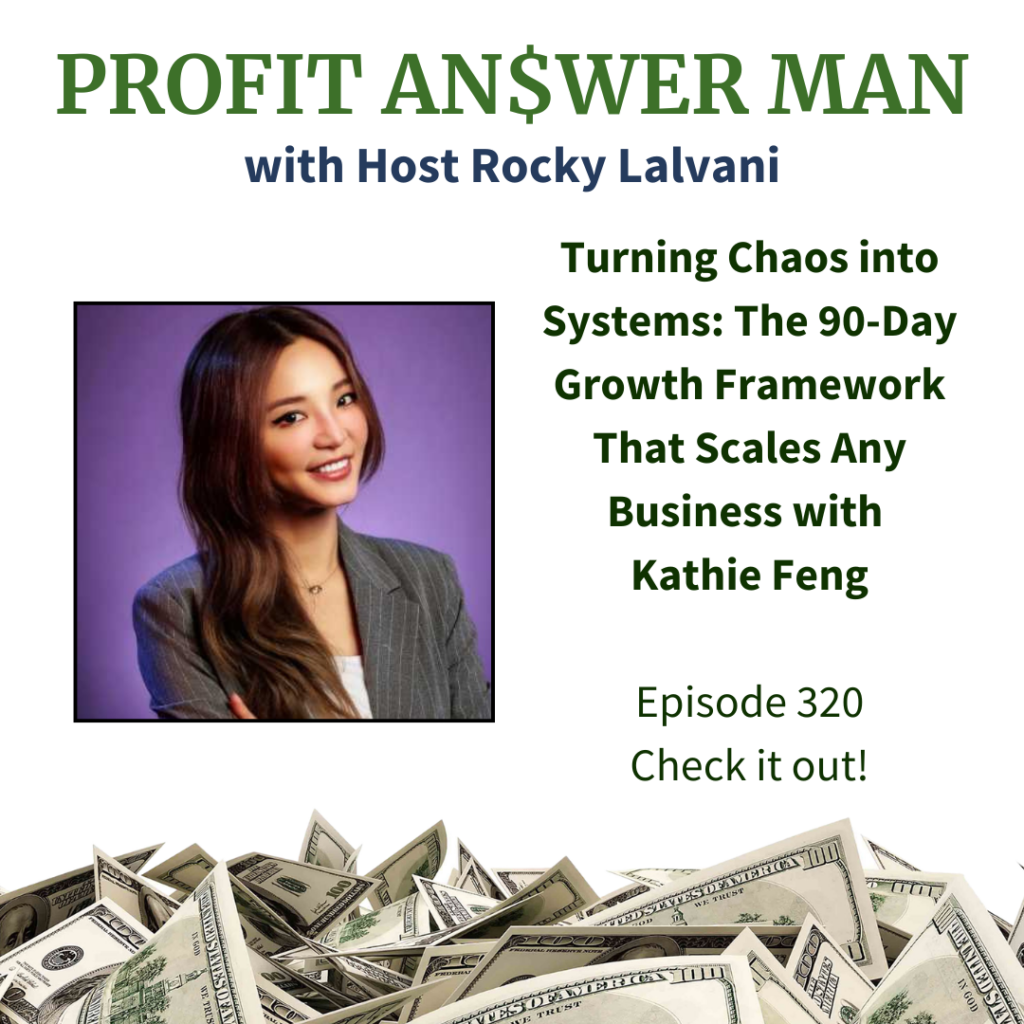
Episode 320 | The Profit Answer Man I Featuring Kathie Feng
From Guesswork to Growth Engine: What Every Small Business Owner Needs to Know About Marketing Strategy
Marketing is one of the most misunderstood investments a small business owner will ever make. You pour money into ads, hire an agency, post content religiously, and still wonder why the revenue needle barely moves. The problem, more often than not, isn’t your product. It isn’t even your budget. It’s the absence of a real system, one built on strategy, data, and a deep understanding of who your customer actually is.
Kathie Feng knows this world intimately. With over 13 years of experience leading growth for global brands including Constellation Brands (Corona and Modelo), Pave — an a16z-backed fintech unicorn, Discover, Capital One, and Shiseido, she has sat inside some of the most sophisticated marketing operations in the world. Today, through her company Signal Growth, she and her team bring those same Fortune 500 frameworks to entrepreneurs and small-to-medium businesses ready to scale with clarity and intention. Her conversation on The Profit Answer Man podcast with Rocky Lalvani pulled back the curtain on what actually drives sustainable business growth, and what’s quietly killing it.
Before You Spend a Dollar on Ads, Do This First
One of the most costly mistakes small business owners make is rushing straight to paid advertising before they have answered a more fundamental question: does your product actually solve a problem that the right people are willing to pay to have solved?
Kathie calls this the winning triangle, the intersection of product-market fit, audience clarity, and pricing strategy. Most entrepreneurs are familiar with the concept of product-market fit, but Kathie adds an important layer that often gets skipped entirely: pricing fit.
“You need to find someone that’s passionate, not just like your product, but passionate enough about your product that it’s solving some sort of pain point for them to actually pay the price,” she explains.
Finding that person starts with building a customer feedback loop long before any campaign goes live. Kathie recommends developing clear hypotheses about who your potential customer is, identifying different customer segments, and then reaching out directly to solicit honest feedback. One of her current clients, a fashion AI startup focused on virtual try-on technology, used this exact approach. Rather than assuming who the customer was, they identified distinct pain points, busy professionals who don’t have time to think about style, and people who genuinely struggle with fashion choices, and built their outreach strategy around verifying those hypotheses first.
The payoff of doing this work upfront is enormous. Without it, you risk spending heavily on the wrong audience, solving only part of a problem, or pricing yourself out of a market that might have loved you at a different price point.
Why Your Meta and Google Ads Might Not Be Working
If you’ve ever felt like the platforms are “sucking money” without giving you a return, you’re not alone. This is one of the most common frustrations Kathie hears from the SMBs she works with.
The issue usually isn’t the platform itself. It’s the approach.
“A lot of SMBs think they just need to get their Meta campaign and Google campaign launched and they’re set, that the money will come in and people will buy,” Kathie explains. “It’s usually not the case.”
What’s missing is a structured test-and-learn strategy. Rather than launching a single campaign and hoping for the best, Kathie recommends treating your ad campaigns as experiments with clear variables. In the info product space, for example, that might mean testing different pricing tiers against different audience segments across Meta and Google simultaneously, then using the data to understand what’s working, what isn’t, and how to scale from there.
There’s also a creative dimension that many business owners overlook entirely. The average view time on Meta is around one to two seconds. That means your most important message, your hook, needs to land almost instantly. How you structure that first two seconds of an ad is an art form in itself, and it has an enormous impact on whether the algorithm rewards your campaign with impressions or buries it.
Kathie’s guidance: control what you can control. Your message clarity, your creative quality, your adherence to platform best practices, these are all within your power. Once those elements are dialed in, the algorithm has what it needs to find the right people for you.
How to Know If Your Marketing Agency Is Actually Delivering
Hiring a marketing agency is one of the highest-stakes decisions a small business owner makes, and one of the easiest to get wrong. Kathie, who has managed over 20 agencies throughout her corporate career, puts it plainly: “They tell a beautiful story because that’s what marketers do.”
So how do you cut through the pitch and evaluate whether an agency will genuinely deliver results?
Start by asking for campaign results and performance benchmarks early in the conversation. Every reputable agency should be able to point to specific outcomes they’ve achieved for comparable clients and explain what benchmarks they’re working toward for your business. On Meta, for example, Kathie notes that her clients typically see return on ad spend in the range of eight to ten times, a standard some agencies would describe as exceptional, but one she considers achievable with the right strategy in place.
Second, dig into their methodology. Ask them to walk you through how they identify audiences, structure campaign tests, and make optimization decisions. The reasoning behind the strategy matters just as much as the strategy itself.
Third, and perhaps most practically, run a pilot before committing to a larger scope. Give the agency 90 days with clearly defined KPIs and hold them to those milestones. If they can’t demonstrate meaningful progress within that window, it may simply not be a fit.
“I constantly generate results for my clients within the first 90 to 120 days because we have a methodological framework and step-by-step milestones,” Kathie explains. “So you know exactly what we’re doing for you.”
That level of transparency and accountability is the standard every business owner deserves, and should demand.
High Ticket vs. Low Ticket: How Your Sales Process Should Shift
Not all offers require the same closing process, and treating them the same way is a costly mistake.
For offers priced under approximately $2,000, Kathie believes AI-powered automated systems can handle the conversion process effectively. The right CRM, whether that’s Go High Level, Kajabi, or a similar platform, can manage phone leads, SMS follow-ups, and email sequences in a way that keeps prospects engaged without requiring constant human intervention.
For high-ticket offers in the range of $7,000 and above, however, a more personal touch becomes essential. At that price point, people need to build genuine trust and familiarity before they are willing to pull out their credit card. That’s where an experienced closer — someone who can advocate for your business in an authentic, non-pushy way, becomes a meaningful investment.
The distinction matters because it shapes not just your sales process but your entire funnel architecture. Knowing where human connection needs to show up in your customer journey, and where automation can carry the weight, is a strategic decision that has a direct impact on your conversion rates and your bottom line.
The Consumer Decision Journey Is No Longer Linear — Here’s What That Means for You
If you’ve ever felt like it’s getting harder to predict when or why a customer decides to buy, you’re not imagining it. Consumer behavior has fundamentally changed.
Fifteen years ago, the marketing funnel was relatively straightforward, awareness led to consideration, which led to conversion. Today, that journey is scattered across multiple simultaneous touchpoints. A potential customer might see your ad on social media, watch your video on another platform, receive your email, and encounter your brand in a completely different context, all in the same afternoon, before making any decision at all.
“It’s no longer a linear decision process,” Kathie explains. “The conversions are no longer linear and no longer predictable.”
What this means in practice is that your job as a marketer, or as someone overseeing your marketing, is to show up consistently, compellingly, and correctly across the channels where your audience lives. You cannot always control when someone is ready to buy. You can control how clear, relevant, and resonant your message is every single time they encounter your brand.
This is also why simply launching a campaign and stepping back is rarely enough. The follow-up sequence, email, SMS, retargeting, is what keeps your brand present through the messy, nonlinear journey that leads to a purchasing decision.
What AI Means for Your Marketing Right Now
AI is reshaping marketing workflows in ways that are already significant and will only accelerate. For small business owners, this cuts both ways.
On one hand, AI tools are making it easier than ever to produce content, automate customer service, manage appointment setting, and optimize ad campaigns. The barriers to execution have dropped considerably, and founders who learn to harness AI effectively gain a real competitive edge.
On the other hand, the explosion of AI-generated content has created a crowded, noisy marketplace where standing out requires more than just volume. Kathie notes that while AI-generated content has become more sophisticated and harder to identify on the surface, patterns still emerge for trained eyes, and authenticity, specificity, and genuine expertise remain powerful differentiators.
Her advice: embrace AI as a tool that amplifies your capacity, not as a replacement for strategic thinking. The frameworks, the audience insights, the creative judgment, those still require human intelligence and experience to get right. AI can help you execute faster, but it cannot replace the strategy that tells it what to execute.
The 90-Day Revenue Engine: What Getting Started Actually Looks Like
For founders wondering where to even begin, Kathie’s approach centers on a structured 90-day framework designed to install the foundations of a predictable revenue system. Within that window, the work typically involves clarifying the target audience, validating the product-market and pricing fit, establishing a test-and-learn campaign structure, and identifying the funnel bottlenecks that are quietly leaking revenue.
The goal isn’t just short-term results, though those matter. It’s building the infrastructure that makes growth repeatable and scalable without requiring the founder to be personally involved in every moving part.
That’s the difference between marketing as a series of tactics and marketing as an engineered system. One depends on luck and effort. The other depends on strategy and data.
The Bottom Line
Growth, as Kathie Feng puts it, isn’t luck. It’s engineered. And the founders who understand that, who invest in the right system, ask the right questions, and hold their partners accountable to real results, are the ones who build businesses that compound over time rather than plateau.
Whether you’re just beginning to think about your marketing strategy or you’re deep in the weeds trying to figure out why your current approach isn’t delivering, the principles Kathie shared are a powerful place to start: know your audience before you spend, demand transparency and benchmarks from anyone you hire, control what you can control, and build a system that works even when you’re not watching it.
About Kathie Feng
Kathie Feng is a founder and Growth Architect who helps businesses turn momentum into market dominance.
With more than 13 years of experience leading growth for global brands, Constellation Brands (Corona, Modelo), Pave (a16z-backed fintech unicorn), Discover/Capital One, and Shiseido, she brings enterprise-grade strategy to founder-led companies ready to scale with clarity and intention.
Through her company, Signal Growth, Kathie and her team, with combined experience of 5 decades, engineer predictable revenue by installing the same data-driven, AI-powered frameworks used by Fortune 500 and multinational brands.
Her work blends systems thinking, consumer psychology, and operational discipline, giving founders access to the rigorous, scalable infrastructure normally reserved for billion-dollar organizations.
Her multicultural background—having been to 6 continents, 42 countries, and speaking 5 languages, shapes her ability to decode human behavior, refine messaging across cultures, and unlock deeper emotional resonance in markets crowded with noise. She believes growth isn’t luck; it’s engineered. And the right system transforms both the business and the founder leading it.
Kathie speaks on:
- AI-powered growth systems
- Modern-day growth funnel architecture
- Founder psychology and decision-making
- Consumer-centric positioning, messaging & behavioral strategy
- Building 90-day revenue engines
- Scaling without chaos or burnout
Links
Website: https://signalgrowth.webflow.io/
LinkedIn: https://www.linkedin.com/in/kathiefeng/
Profit Blueprint Calculator I Profit Comes First: https://lp.profitcomesfirst.com/profitblueprintcalc-page
Watch the full episode on YouTube: https://www.youtube.com/@profitanswerman
Sign up to be notified when the next cohort of the Profit First Experience Course is available!
Free Copy of the Profit Blueprint Book: https://lp.profitcomesfirst.com/landing-page-page
Monthly Newsletter signup: https://lp.profitcomesfirst.com/newsletter-signup
Relay Bank (affiliate link): https://relayfi.com/?referralcode=profitcomesfirst
Profit Answer Man Facebook group: https://www.facebook.com/groups/profitanswerman/
My podcast about living a richer more meaningful life: http://richersoul.com/
Music provided by Junan from Junan Podcast
Any financial advice is for educational purposes only and you should consult with an expert for your specific needs.