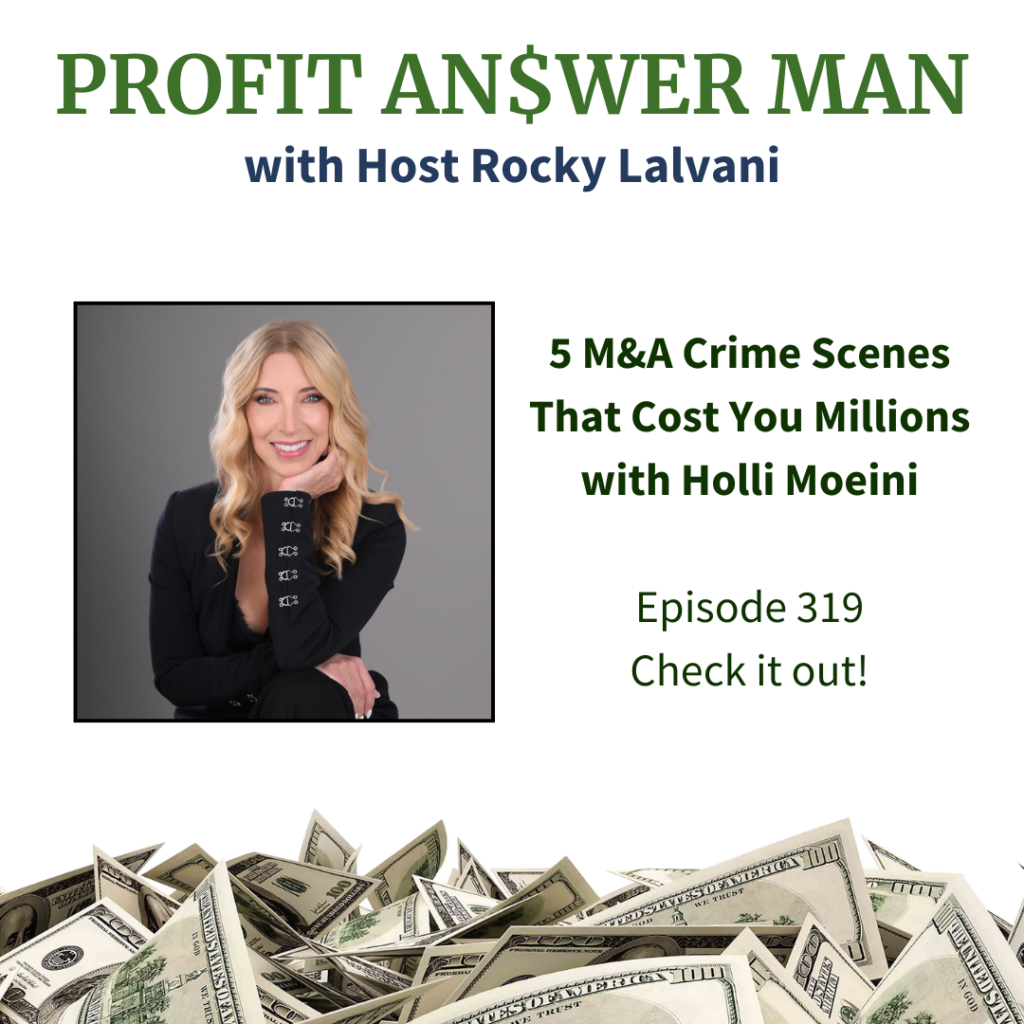
Episode 319 | The Profit Answer Man I Featuring Holli Moeini
5 M&A Crime Scenes That Cost You Millions
You built this business from nothing. Revenue is up. You are finally in a position where someone might want to buy it, or maybe that call has already come in: “Want to sell? Send me your financial statements.” You are excited. You think you are ready. And then somewhere between the letter of intent and the wire transfer, you lose hundreds of thousands of dollars and you do not even know it happened.
That is the reality for most business owners who enter the M&A process without understanding where the landmines are. In this episode of Profit Answer Man, I sat down with Holli Moeini, a 35-year CPA and fractional CFO who helps buyers and sellers prepare for mergers and acquisitions. Holli has seen the inside of enough deals to know exactly where the money disappears, and she walked us through what she calls the five “crime scenes” of M&A. Whether you are thinking about selling next year or you have no plans to sell at all, what she shared will change how you look at your financial statements starting today.
Your Balance Sheet Is the Document Nobody Reads (And It Is Costing You)
Holli asked a room full of CEOs and founders a simple question: who reads their P&L every month? Every hand went up. Who reads their balance sheet every month? The only hand that went up belonged to the lone accountant in the room.
That silence is where the trouble starts. As Holli put it, “If your balance sheet is wrong, your P&L is wrong. So it’s like every month you’re reading only half the story.” Most business owners live in the P&L. They know their revenue, they have a general sense of their expenses, and they check their net income. But the balance sheet is where the mispostings, the timing issues, and frankly, the fraud all end up. Holli said it bluntly: “All the bodies get buried on the balance sheet because nobody looks there.”
Here is what makes this so dangerous. Errors on the balance sheet directly impact your EBITDA, which is the number your company gets valued on when you sell. So a seller walks into a deal thinking their earnings support a certain price, and then the buyer’s accountants run a quality of earnings analysis and the whole story falls apart. The deal gets renegotiated, and the seller loses money they thought they had.
The fix is simpler than most people think. Holli said she can teach any CEO to read a balance sheet in 15 minutes. The key is pulling 12 months side by side and looking for changes. If something went up or down, ask why. Ninety percent of the balance sheet does not change month to month. Focus on the 10 percent that does. In our practice, we automate this. The system highlights what changed, whether it is thumbs up or thumbs down, and we only dig when something flags. Most business owners get stuck because they try to look at everything, their heads hurt, and they stop looking altogether. The answer is not to look at more. It is to look at the right things.
The 30-20-10 Rule: Diagnose Your P&L in Minutes
Before you can sell a business, or even run one well, you need to know if your P&L is structurally healthy. Holli shared a framework she credits to Adam Coffey, author of Empire Builder and a CEO with $2.5 billion in exits. It is called the 30-20-10 rule, and it is one of the fastest diagnostic tools I have seen.
Your gross margin must be above 30 percent. If it is not, you have a cost problem or a pricing problem. Your SG&A (selling, general, and administrative expenses) should be less than 20 percent of revenue. If it is higher, you have an overhead problem. And your net income needs to be at least 10 percent. If you are below that, you cannot fund your own growth. You will run out of cash.
Holli added an important nuance for e-commerce and B2C businesses that spend heavily on customer acquisition. You can separate the selling component from G&A. The selling piece should sit between 12 and 15 percent, and the remaining G&A should be under that 20 percent ceiling. This gives business owners who are intentionally investing in growth a more accurate picture without ignoring the underlying discipline.
One more diagnostic signal from Holli: if your gross margin is bouncing up and down month to month like a heartbeat, that is almost always an accounting issue, not a business issue. Timing problems, mispostings, and chart of accounts errors create that pattern. Clean it up and the real margin picture emerges.
The Five Crime Scenes of M&A
Holli described five moments in the M&A journey where money and risk change hands, often without the seller even realizing it. She calls them crime scenes, and after hearing her describe them, the name fits.
Crime Scene One: The Financial Story. This is the foundation. If your financial records are messy, inconsistent, or cash-based when they should be accrual, you are starting from a losing position. Sellers who send tax records instead of properly prepared financial statements are signaling to buyers that they do not know their own numbers. Tax records are built for compliance, not for showing value. Buyers want to see three years of clean, consistent financial history that tells a story of trust. That consistency is what pushes you from the bottom of a valuation range to the top. If the EBITDA multiple range is five to eight, your financial story is a major factor in whether you land at five or eight.
Crime Scene Two: Working Capital. This is where things get squishy, and that is Holli’s word. Most sellers assume they will get paid a market price and then keep their accounts receivable and cash. That is not how it works. Buyers expect the business to come with “gas in the tank,” enough working capital to run the business from day one, so payroll can be met the Friday after close. If sellers do not factor working capital into the deal structure, it can cost them potentially millions. And the calculation itself is contested. Accountants do not even agree on how to calculate working capital. Some use a lazy three-month average that may not reflect reality. Sellers who carry more working capital than necessary should not be giving that excess to the buyer.
Crime Scene Three: Due Diligence. This is where most deals fall apart. A CPA firm runs a quality of earnings report on your company, and if your records are not clean, the letter of intent you signed starts getting renegotiated. By this point, promises have been made, money has been mentally spent, and the seller is emotionally committed. That is exactly when the buyer has the most leverage.
Crime Scene Four: Earn Outs. Earn outs are one of the most common ways to bridge the gap between what a seller wants and what a buyer will pay. Holli actually likes earn outs, but she has seen them go badly because of three things: lack of clarity, lack of control, and lack of cadence. She shared a story about a client whose earn out was based on “net revenue,” which the legal document defined as “revenue less bad debts in accordance with generally accepted accounting principles.” That sounds straightforward until you realize GAAP is gray. Four months after close, the buyer’s accountants started writing off receivables more aggressively. If Holli had not insisted on a paragraph-long plain-language definition of exactly what counted as a bad debt, the client would have lost a significant portion of an earn out worth 20 percent of the purchase price, which ran into millions of dollars.
Crime Scene Five: Integration. This is the one that gets the least attention and causes some of the deepest damage. When a business changes hands, people leave. And when people leave, money walks out the door with them. Holli stressed that both buyers and sellers need to plan for the human component from the very beginning, not as an afterthought after close.
What Happens After the Wire Hits
I asked Holli a question I already knew the answer to: when the wire finally comes into the bank account and it is all said and done, is it a letdown?
Her answer was direct. Grief sets in. Real grief. It does not matter how many zeros are on the wire. Sellers go through every stage of it. Even if the money changed their life and secured their retirement, there is a sadness that comes with letting go of something you built. There are now coaches who specifically support sellers through the emotional aftermath of a sale, and Holli sees that grief up close with her clients.
I see a version of this with the business owners I work with who are not selling. Running a business is hard. Money is emotional. And most owners are making decisions based on incomplete information because they have never looked at the full financial picture. When you finally understand what the numbers say, you can make better choices. That is what it is all about.
Rocky’s Perspective
What hit me hardest in this conversation is something I tell my clients all the time: the disciplines that make your business sellable are the exact same disciplines that make it profitable right now. Clean financials, a leadership bench that does not depend on you, systems that run without you being the bottleneck. You do not need to be planning a sale to benefit from this.
I had a conversation the same day we recorded this episode with a company that is doing fine on the surface. Revenue is good. But I told them, if you ever want financing, your balance sheet will not support it. Not because they are doing anything wrong, but because the owners are taking too much money out. When a banker looks at how much skin you have in the game and it is not there, that is a problem. I have seen fast-growing companies hit a blip, their P&L looks great, and their balance sheet says non-lendable. That is a position you never want to be in.
Your Action Step
Pull your balance sheet for the last 12 months. Line them up side by side. Look at what changed. You are looking for accounts receivable trending in the wrong direction, inventory days on hand creeping up, and anything that should not be there. Holli said you can learn to read it in 15 minutes. Do not let another month go by where you are only reading half the story.
The Bottom Line
Every business owner will exit at some point. The only question is whether you will be prepared when that moment comes or whether you will bumble your way through and lose money you never even knew was on the table. The five crime scenes Holli described are not hypothetical. They happen in deal after deal. The good news is that every one of them is fixable, and fixing them makes your business better whether you sell or not.
About Holli Moeini
Holli Moeini is a CFO, CPA, and M&A advisor who helps buyers and sellers strengthen their companies, reduce risk, and maximize value at every stage of a deal. Known for blending financial rigor with real operational experience, she brings clarity and confidence to complex decisions.
Early in her career, Holli played a key role in a nine-figure exit, using GAAP discipline to improve performance and strengthen valuation. That experience shaped her precise, transparent approach to value creation. As an EVP and CFO, she led finance, operations, IT, security, and companywide strategy, guiding organic growth, acquisitions, and major systems implementations. She understands what it takes to run a business, not just analyze one.
Most recently, Holli helped a founder move from not being ready to sell to a successful eight-figure exit in 12 months, uncovering and protecting millions of dollars of value while keeping risk balanced from preparation through closing. A graduate of Pacific Lutheran University, Holli is trusted for her steady leadership, practical insight, and ability to simplify complexity while delivering exceptional outcomes.
Links
Book: https://www.amazon.com/Finding-Missing-Millions-Holli-Moeini/dp/1967386501
Instagram: instagram.com/hollimoeini
LinkedIn: linkedin.com/in/hollimoeini
Profit Blueprint Calculator I Profit Comes First: https://lp.profitcomesfirst.com/profitblueprintcalc-page
Watch the full episode on YouTube: https://www.youtube.com/@profitanswerman
Sign up to be notified when the next cohort of the Profit First Experience Course is available!
Free Copy of the Profit Blueprint Book: https://lp.profitcomesfirst.com/landing-page-page
Monthly Newsletter signup: https://lp.profitcomesfirst.com/newsletter-signup
Relay Bank (affiliate link): https://relayfi.com/?referralcode=profitcomesfirst
Profit Answer Man Facebook group: https://www.facebook.com/groups/profitanswerman/
My podcast about living a richer more meaningful life: http://richersoul.com/
Music provided by Junan from Junan Podcast
Any financial advice is for educational purposes only and you should consult with an expert for your specific needs.