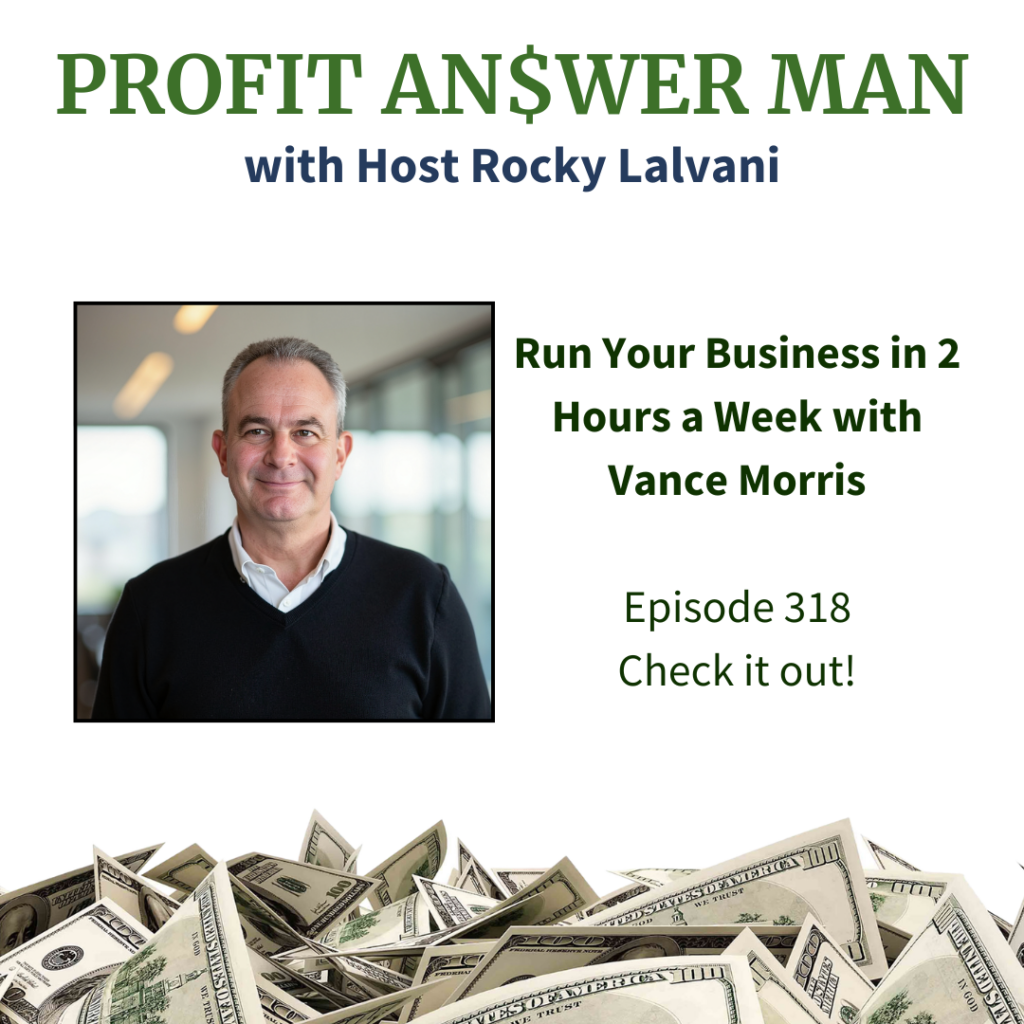
Episode 318 | The Profit Answer Man I Featuring Vance Morris
90 Minutes a Week to Run 3 Businesses: What Disney Taught Vance Morris About Profit, Systems, and Freedom
You are growing. Revenue is up. You added people. You added services. And somehow you are working more hours than you were two years ago with less cash flow to show for it.
That is not a growth problem. That is a systems problem. And until you solve it, more revenue is just going to make the mess bigger.
On a recent episode of the Profit Answer Man podcast, I sat down with Vance Morris, a former Disney leader who spent over 10 years working for the mouse in Orlando. Today Vance owns three businesses, a premium carpet cleaning company, an oriental rug washing facility, and a mold remediation company. He manages all three in about 90 minutes a week. Not because he got lucky, not because he found some shortcut, but because he built systems so simple that anyone on his team can follow them without thinking.
What he shared in our conversation is something every small business owner doing $1M to $10M in revenue needs to hear.
Disney Runs on Three Words. Your Business Can Too.
When most people think about Disney, they think about magic. Vance thinks about checklists. During his decade at Disney, the biggest lesson he took away was that Disney does not run on pixie dust. It runs on three words: What to do, How to do it, and Why we do it that way.
That is the entire operating system. Every role, every task, every interaction is built on that framework. And the reason it works is because it is simple enough for a minimum wage employee to understand on day one.
Vance brought that framework into his carpet cleaning business and it changed everything. When a technician shows up to the shop in the morning, there is no guessing. They check the truck. They check the air pressure. They clean the van. Every single day, same sequence, same standard. Like a pilot running a preflight checklist.
And as Vance put it, “Would you get on an airplane where the pilot just decided, you know what, I’m not doing the checklist today? I’m just going to wing it. Why is your business any different?”
Here is what I find with most business owners. They are allergic to simplicity. They think simple means unsophisticated. But simple is what scales. Complexity is where the screw-ups happen. Disney proved that. Chick-fil-A proved that. And Vance proved it in a carpet cleaning company in Maryland.
The 90-Minute Week Is Not a Gimmick. It Is the Result of Systems.
Vance was very clear about this. His 90-minute week is not the four-hour work week fantasy. It is literal. He spends about an hour in a structured weekly meeting with his general manager and about 30 minutes on the checkbook. That is it.
But getting there required building the machine first. A marketing system with 20 to 30 automated campaigns running at any given time. Postcards going out that he does not even know about. An operations system where every step from the front door to the follow-up is documented and repeatable. And a general manager whose job is not to reinvent the wheel but to manage the systems already in place.
Vance told his GM something I think every business owner should adopt as a rule: “Just manage the systems. Don’t screw with anything. If you want to change something, we’ll talk about it at our weekly meeting. But don’t mess with anything until we chat.”
That is not micromanagement. That is protecting the system that gives you your freedom.
I see this constantly in my work as a Strategic CFO. Owners who are doing $3M, $5M, even $8M in revenue and they are still the one answering every question, approving every decision, touching every job. They have employees, but they do not have systems. So they are paying people to wait for instructions instead of paying people to execute a process.
The shift is not about working harder or hiring more people. It is about documenting what works and letting the system run.
70 Referral Partners and Zero Cold Calls
One of the most valuable parts of my conversation with Vance was his referral partner system. This is not a theory. He has over 70 active referral partners generating roughly one to two referrals per month each. That is a steady pipeline of warm leads coming in without a single cold call.
The system starts with a candy bowl. Literally. Vance’s salesperson identifies businesses that serve the same customer but sell something different, think plumbers, electricians, real estate agents, pest control companies. The salesperson walks into the office, introduces themselves to the front desk person, and offers to leave a bowl of candy for the office along with a few brochures.
Nine out of ten say yes because there is no ask. No meeting request. No pitch. Just value.
Then the salesperson comes back every week to refill the candy bowl. That is the excuse to return without being a pest. Each visit, they leave a small extra touch. Post-it notes with the company logo. A seasonal gift. Always giving, never selling.
After five or six weeks of consistent visits, the salesperson finally makes a small ask: “Would it be okay if I did a quick five-minute training for your office on our referral process, or maybe an educational piece on mold or rug care?”
By that point, trust has been built. The office has seen consistency. And the answer is almost always yes.
What I love about this system is that it is not designed to get a flood of referrals from one source. It is designed to get one or two a month from each. But when you have 70 sources doing that, the math takes care of itself. And referred customers are, as Vance said, “a yes waiting to happen.”
This works online too. Vance adapts the same principle to Reddit, Facebook groups, and LinkedIn groups. Show up, answer questions, provide value for 30 to 60 days without ever asking for the sale. Then reach out to the group owner and offer a short training. The candy bowl is just the metaphor. The principle is the same: give first, give consistently, and the business follows.
Your Newsletter Should Entertain, Not Sell
Vance sends a monthly print newsletter to his customers. But if you are imagining a promotional flyer about carpet cleaning specials, you are thinking about it wrong.
His newsletter reads like Readers Digest Light. Family photos. Stupid criminal stories that people apparently love. A Sudoku puzzle or word find that keeps the newsletter sitting on the kitchen counter until the puzzle is finished. The content is personal, entertaining, and has almost nothing to do with carpet cleaning.
The selling happens separately. Two weeks after the newsletter lands, a postcard goes out with the monthly offer. Then weekly emails combine stories from the newsletter with the postcard promotion. The customer gets touched four to six times a month across different media, but the relationship-building and the selling never happen in the same piece.
Vance said something that stuck with me: “It’s not the customer’s job to remember you. It’s your job to remind the customer that you exist.” And when the only time a customer hears from you is when you want money, that is not a relationship. That is a transaction.
He shared a story that makes the point better than any statistic could. His daughter Emma was in ballet when she was five, and he put a photo of her in her tutu in the newsletter. He ran that feature every year for six or seven years. One day in the grocery store, a woman came running up to his daughter and said, “Oh my God, Emma, how is your recital?” The woman was a customer who had watched Emma grow up through the newsletter.
That is retention. That is a client for life. And it came from a four-page newsletter on a folded piece of paper, not a fancy marketing funnel.
Hire to Culture, Fire to Standards
Vance made a comparison that I think about often. McDonald’s and Chick-fil-A hire from the exact same applicant pool: local high school kids. McDonald’s can barely get them to grunt through the drive-through speaker. Chick-fil-A gets those same kids to say “my pleasure” and deliver a genuinely friendly experience.
The average McDonald’s location does about $4.5 million in revenue. The average Chick-fil-A does over $8 million. And Chick-fil-A is closed one day a week.
The difference is not talent. It is culture. And culture is a system.
Vance hires to values. He can train anyone to clean a carpet or carry a tray. He cannot train someone to be nice. He cannot train someone to show up on time. Those are things you either bring to the job or you do not.
And when it comes to accountability, Vance does not wait around. His weekly meeting with his GM includes a full after-action report: financials, number of new contacts, referral partner visits, callbacks, everything measured against targets. If someone misses their numbers one week, he asks why and listens. If the reason is legitimate, like covering for a sick employee, he works with them to prevent it from happening again. If the reason is weak two weeks in a row, that person is gone.
“I fire fast,” Vance said. “Unemployment compensation be damned. I can’t afford to have anybody not following directions because they’re affecting my income.”
That might sound harsh. But the alternative is worse. The alternative is carrying someone who is not following the system, which means the system breaks down, which means you are back to being the bottleneck, which means the 90-minute week disappears.
Rocky’s Perspective
Here is what I want you to take from this conversation.
I work with business owners every day who are growing but not seeing that growth show up in their profit or their cash flow. They are doing more revenue, hiring more people, and somehow ending up with less money in their pocket. When I look under the hood, the issue is almost always the same. There is no system. The owner is the system. And that does not scale.
Vance proved that a carpet cleaning company can run on autopilot with a simple framework and the discipline to stick with it. He uses Profit First. He has for at least eight years. He pays himself first. He manages his money through the system, and he manages his business through a system. That is not a coincidence.
You do not need to be a former Disney leader to do this. You need to be willing to document one process, hand it off, and inspect what you expect. That is the starting point.
Your Action Step
Today, pick one task you do repeatedly in your business. Pull out your phone, hit record, and walk through exactly how you do it. Upload that recording to an AI tool and ask it to create a What, How, and Why SOP from the transcript. Then hand it to someone on your team, walk them through it, and let them run it next week.
That is one system. That is the first 90 minutes you get back. And once you see it work, you will want to do it again.
The Bottom Line
More revenue is not the answer. More hours are not the answer. The answer is a business that runs on systems simple enough that anyone can follow them, consistent enough that you can trust the outcome, and strong enough that you can step away and let the machine do its job.
Vance Morris did it with three businesses. You can do it with one.
About Vance Morris
Vance is a former Birth Control Factory Security Guard and turned that into a wild journey from Disney leader to bankrupt out-of-work executive to carpet cleaner to successful entrepreneur.
Today, he’s the guy businesses call when they’re bleeding profit and can’t figure out why. He delivers real-world systems that stop customers from quietly disappearing and stop money from leaking out the back door. He’s the only expert on the planet, who blends direct-response marketing with engineered customer loyalty and retention.
Links
https://www.deliverservicenow.com
https://www.linkedin.com/in/vancemorris/
Link to the gift “52 Ways To Wow Your Customer”. https://wow52ways.com
Profit Blueprint Calculator I Profit Comes First: https://lp.profitcomesfirst.com/profitblueprintcalc-page
Watch the full episode on YouTube: https://www.youtube.com/@profitanswerman
Sign up to be notified when the next cohort of the Profit First Experience Course is available!
Free Copy of the Profit Blueprint Book: https://lp.profitcomesfirst.com/landing-page-page
Monthly Newsletter signup: https://lp.profitcomesfirst.com/newsletter-signup
Relay Bank (affiliate link): https://relayfi.com/?referralcode=profitcomesfirst
Profit Answer Man Facebook group: https://www.facebook.com/groups/profitanswerman/
My podcast about living a richer more meaningful life: http://richersoul.com/
Music provided by Junan from Junan Podcast
Any financial advice is for educational purposes only and you should consult with an expert for your specific needs.