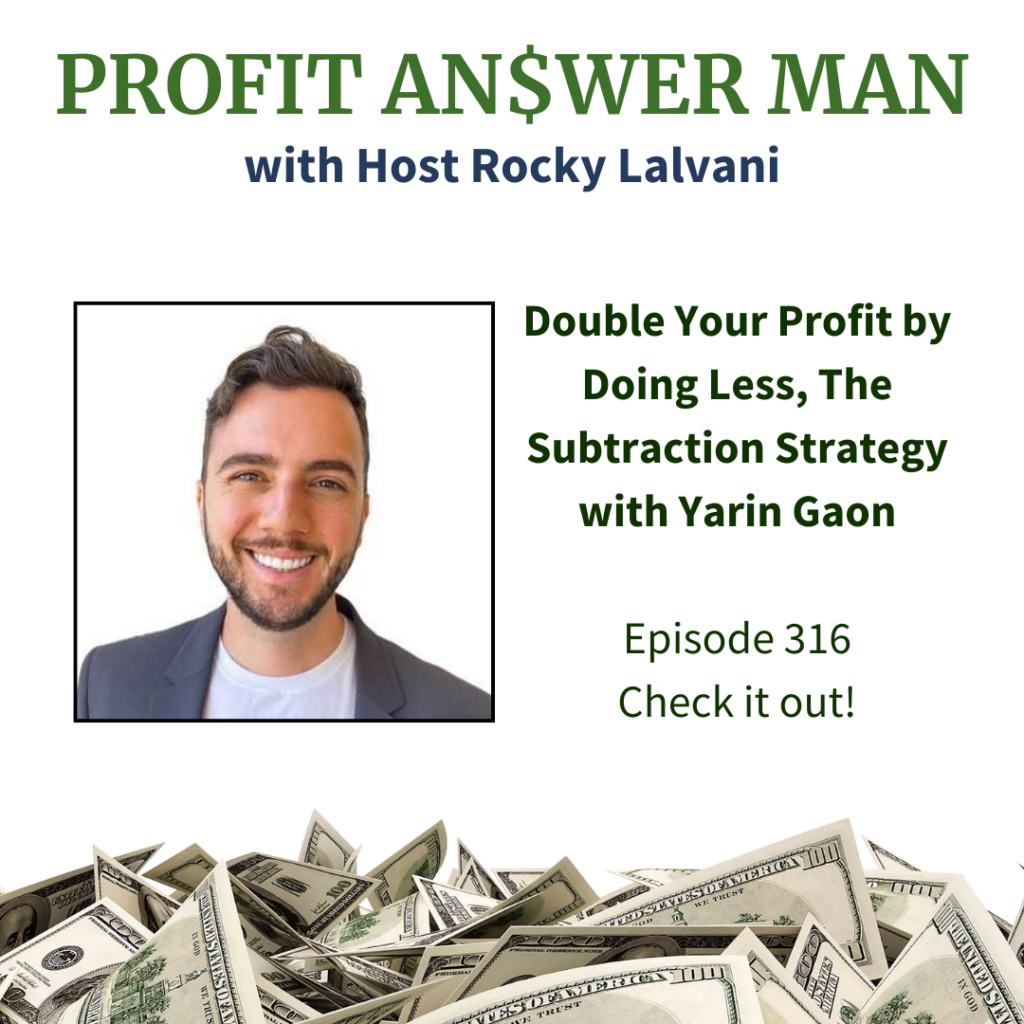
Episode 316 | The Profit Answer Man I Featuring Yarin Gaon
The Profit Paradox: Why More Revenue Is Killing Your Business (And What to Do About It)
When you’re running a small business, the conventional wisdom seems simple: grow revenue, and profit will follow. Yet after mentoring over 400 founders and turning around dozens of struggling startups, Yaron Gaon has discovered something that contradicts everything most business owners believe. At a certain stage of growth, usually between $2 million and $4 million in annual revenue, companies hit an invisible wall. Revenue keeps climbing. The business looks successful on paper. But profit actually shrinks.
This isn’t a coincidence. It’s a predictable pattern that catches entrepreneurs off guard because nobody warns them about it.
Understanding the Growth by Addition Trap
When you start a business from zero, there’s only one way to grow: by adding. You add clients, products, services, revenue streams. You experiment to see what sticks in the marketplace. You throw things at the wall and keep what works. This approach is not only natural, it’s necessary at the early stage.
The problem emerges when this same addition-based strategy continues past the $2 million mark. By this point, you’ve proven product-market fit. You’ve proven you can execute and sell. Yet many founders keep applying the same playbook that got them here: add more of everything.
Here’s where the math breaks down. Not every part of your business is equally profitable. Some revenue streams, customer segments, and product lines generate significant margins. Others barely break even or actually lose money when you account for the true cost of serving them. When you grow by addition, you’re growing everything simultaneously. You’re diluting your profit because you’re scaling the winners and the losers at the same rate.
It’s like running a restaurant where 20 percent of your menu items generate 80 percent of your profit. If you keep adding menu items without removing anything, you’re making the problem worse. More complexity. More SKUs to manage. More kitchen time spent on low-margin dishes. Your overall profitability declines even as revenue increases.
The Hidden Complexity Problem
There’s another layer to this issue that most business owners don’t see until it’s too late. At the startup stage, the founder is everywhere. All the knowledge about how to run the business lives in the founder’s head. When there are problems, the founder solves them directly. The operation is lean because there’s no fat to cut.
As you scale to $1 million or $2 million in revenue, you start hiring. You bring on a team. But here’s what happens: these employees don’t have the systems and processes documented. They learn by working closely with the founder or a senior person. When problems arise, they escalate up. The founder is constantly firefighting.
Then you hit $2 million or $3 million. Now you’ve added another layer of management. The original team leads are managing new hires. But those original team members never received formal training in systems and processes. They learned through osmosis. So now you have people two or three steps removed from the founder, operating without clear guidelines, creating inconsistent results.
What should have been a small decision made 10 times a day is now being made 100 times a day across your organization, and each decision is slightly different. Quality declines. Costs increase. Profit gets squeezed.
The Financial Clarity Crisis
The real breakthrough comes when a business owner can answer one simple question: where is my profit actually coming from?
Most founders can tell you where revenue comes from. That’s easy. You sold $3 million in services or products this year. But can you tell me which services or products generated 80 percent of that profit? Can you identify which customer segments are actually profitable versus which ones consume resources without generating returns?
This is where most business owners get stuck. They receive a P&L statement from their accountant or bookkeeper, and it might as well be written in ancient Greek. The numbers are there, but they don’t tell a story. They don’t answer the critical question: where is profit coming from?
Even worse, most P&Ls are contaminated with what we call “junk expenses.” These are personal expenses that get buried in the business P&L because they reduce your tax bill. A car that has nothing to do with the business. Personal meals. Travel that was partially personal. These decisions make sense from an IRS perspective in the moment, but they destroy your ability to make smart financial decisions because your numbers are muddy.
When you calculate adjusted EBITDA or adjusted profit, you strip out these junk expenses. You get to the truth of what your business actually generates. And only then can you start asking intelligent questions about where to focus your effort and capital.
Strategy Before Tactics: The Missing Piece
Here’s where most operational systems like EOS (Entrepreneurial Operating System) miss a critical step. EOS is excellent at what it does: it ensures everyone in your organization is rowing in the same direction. It provides accountability, clear metrics, and operational discipline.
But EOS doesn’t answer the upstream question: are we rowing in the right direction?
Many businesses at the $2 million to $5 million stage implement EOS and still struggle because they haven’t achieved strategic clarity first. They haven’t asked the hard questions about what to double down on and what to eliminate. They’ve just organized their current chaos.
The framework that works starts with financial clarity. You examine your P&L, clean it up, and identify where profit actually comes from. Then you move to strategic clarity. You decide what segment of customers you want to serve. What product or service line you want to focus on. What capabilities and advantages you have that you want to double down on. What are you saying no to?
Only after you have financial clarity and strategic clarity do you implement operational systems. Then EOS makes sense. Then your dashboard and metrics mean something because everyone is executing against a clear strategy, not just trying to optimize a business that might not be worth optimizing.
The Three Driver Framework: Revenue, Profit, and Cash Flow
Most business owners think in terms of revenue. They think in terms of the top line. But revenue is only one dimension of business health. There are actually three drivers that matter: revenue, profit, and cash flow.
You can have revenue. You can have profit. And you can still have zero cash. This happens more often than you’d think, especially in businesses with long payment cycles or high inventory requirements.
Within each driver, there are five or six levers you can pull. You can increase the average transaction value. You can increase conversion rates. You can reduce customer acquisition costs. You can improve retention. Each lever has a different impact on your three drivers.
The magic comes when you see how all these levers connect across all three drivers. You realize that one small adjustment to one lever might create a disproportionate impact on your bottom line and your cash position. These aren’t 10x changes. They’re small tweaks that compound into dramatic results.
A fractional CFO or a strategic advisor helps you identify which lever has the highest return for the least effort. They show you the math. And when you see the math, the decision becomes obvious.
Testing Without a Hypothesis: The Founder’s Mistake
Most entrepreneurs test ideas without being explicit about what they’re testing. They run a marketing campaign, try a new product, target a new customer segment, and then look at the results. But without a clear hypothesis, the results are just data. They don’t tell you anything.
The smarter approach is to be explicit about your decision first. You decide, based on your financial analysis, that you’re going to focus on a specific customer segment and test your marketing strategy with them. You run the test. You measure against your hypothesis. The results now tell you whether your strategy was right, whether your execution was poor, or whether your assumptions were wrong.
This distinction matters because it changes how you interpret failure. If you test without a hypothesis and things don’t work, you don’t know why. Did the idea suck? Did you execute poorly? Was the market not ready? Did you run out of money before the idea could mature?
When you test with a clear hypothesis, and you fail, you know it’s not an execution problem. It’s a strategic problem. And that’s valuable information.
Profitable Growth Comes from Subtraction, Not Addition
Here’s the counterintuitive insight that separates the founders who build lasting businesses from those who chase vanity metrics: the path to profitability at scale comes from subtraction, not addition.
You’ve built mass. You have enough revenue, enough complexity, enough different activities that you can now see patterns. You can see what works and what doesn’t. The shift that needs to happen, and rarely does, is that you pause. You look at everything you’ve built. And you ask: what am I doubling down on? What am I eliminating?
You take the 20 percent of your activities that generate 80 percent of your profit. You focus on scaling those. You say no to everything else. You eliminate product lines that don’t fit. You stop serving customer segments that aren’t profitable. You shut down operations that consume resources without generating returns.
This feels counterintuitive because we’re conditioned to believe that more is better. But the founders who build the most profitable, valuable businesses are those who have the discipline to be highly specific. They know exactly who they serve. They know exactly what they offer. And they’ve eliminated everything else.
Why Business Owners Don’t Make This Shift
The sad reality is that most business owners understand this intellectually. They’ve read the books. They’ve heard the advice. But they don’t implement it. Why?
Because it requires stopping. It requires pausing the daily grind of running the business to sit down and do analysis. It requires honesty about what’s working and what isn’t. It requires making hard decisions to kill projects, eliminate customer segments, or shut down product lines.
When you’re in survival mode, drowning in day-to-day operations, you don’t have the mental energy for this kind of strategic thinking. The crisis moment, when you can’t make payroll, forces the issue. But by then, your options are limited. You’re making decisions from a position of weakness, not strength.
The founders who get ahead of this are those who get intentional about taking time to do this analysis before they’re forced to. They implement quarterly strategic planning. They create a source of truth, a single document that answers the key questions: Who are we serving? What are we offering? What are our core capabilities? What’s our strategy?
Once that source of truth exists, it becomes easy to say no to shiny objects. When a new opportunity comes along, you ask: does this fit our plan? If the answer is no, you’re not saying no emotionally. You’re saying no because you agreed to a plan, and this doesn’t fit it.
Taking Action: The Fractional CFO Approach
If you’re in the $1 million to $5 million revenue range, the most practical next step is to create financial clarity. Get a clean P&L. Understand where profit actually comes from. Identify your most profitable customer segments and service lines.
You don’t need to hire a full-time CFO. Most small businesses can’t afford one. But you can afford a fractional CFO who focuses on one thing: helping you see your numbers clearly and identify the levers that will have the highest impact on your profit and cash flow.
The return is usually immediate. The investment in clarity pays for itself in the first 90 days because once you know where to focus, the changes you make are low-cost and high-impact.
Yaron Gaon has created a free playbook, available at playbook.fractional.partners, that walks through the exact questions you need to answer to achieve financial, strategic, and operational clarity. It’s the same framework that private equity firms use to make companies more valuable. Now it’s available for founders who don’t have access to elite investor networks.
The question isn’t whether you can afford to invest in clarity. The question is whether you can afford not to.
About Yarin Gaon
Yarin Gaon is an entrepreneur-turned-investor with a proven track record of founding, scaling, and exiting companies. He launched his first company at age 14 and went on to build Israel’s largest e-commerce platform for military goods, which he later sold before relocating to the U.S. He also served as an Entrepreneur-in-Residence at a venture capital firm, where he specialized in turning around distressed startups. With an MBA from Tel Aviv University (and time spent at Kellogg School of Management), Yarin now helps growing companies mature into strong, cash-flowing assets.
Yarin has mentored over 400 businesses through SCORE and the University of Chicago’s Polsky Center. Today, he shares a free playbook built for $1–20M companies based on the exact growth systems private equity firms use—democratized for founders who don’t have access to elite investor networks. His approach focuses on strategy before tactics, helping founders align their goals and scale with clarity and confidence.
Links
Website: https://www.fractional.partners/
LinkedIn: https://www.linkedin.com/in/yaringaon/
https://playbook.fractional.partners/
Profit Blueprint Calculator I Profit Comes First https://lp.profitcomesfirst.com/profitblueprintcalc-page
Watch the full episode on YouTube: https://www.youtube.com/@profitanswerman
Sign up to be notified when the next cohort of the Profit First Experience Course is available!
Free Copy of the Profit Blueprint Book: : https://lp.profitcomesfirst.com/landing-page-page
Monthly Newsletter signup: https://lp.profitcomesfirst.com/newsletter-signup
Relay Bank (affiliate link): https://relayfi.com/?referralcode=profitcomesfirst
Profit Answer Man Facebook group: https://www.facebook.com/groups/profitanswerman/
My podcast about living a richer more meaningful life: http://richersoul.com/
Music provided by Junan from Junan Podcast
Any financial advice is for educational purposes only and you should consult with an expert for your specific needs.