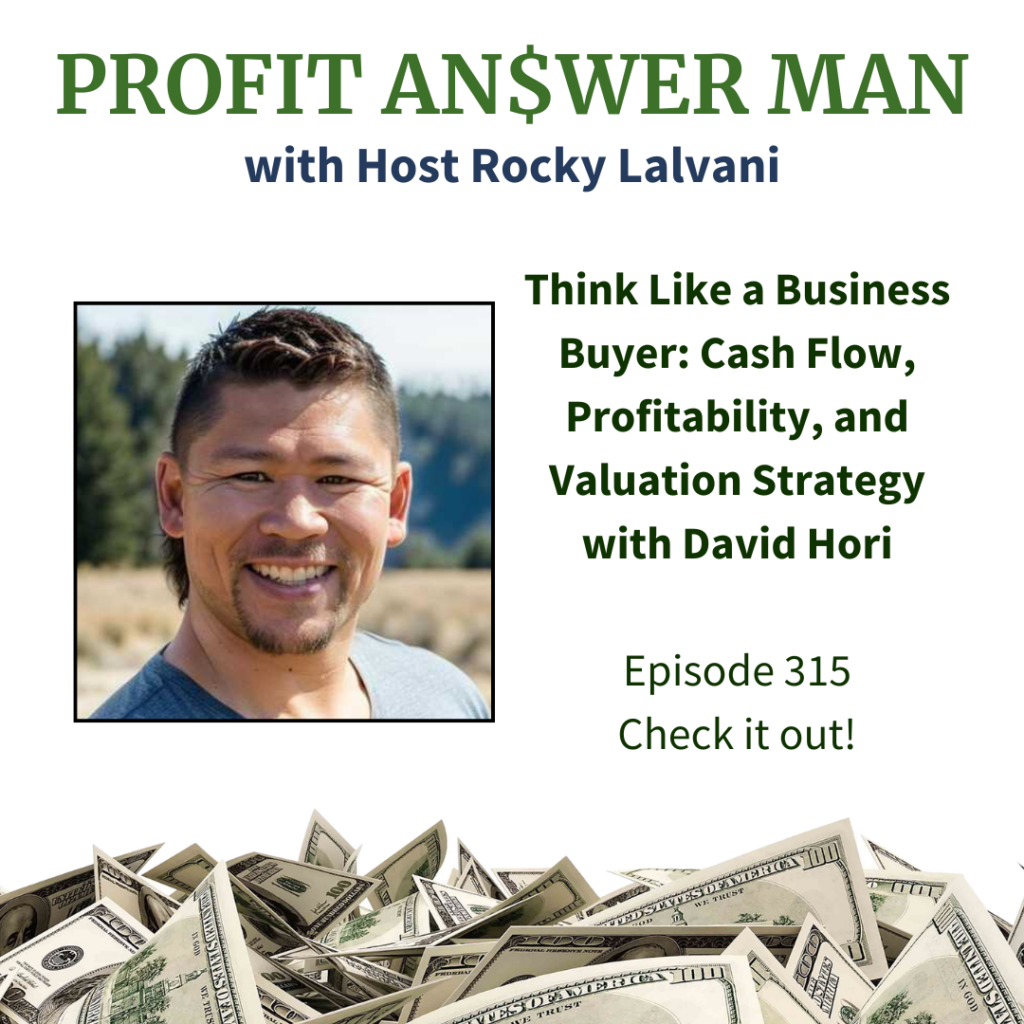
Episode 315 | The Profit Answer Man I Featuring David Hori
How to Buy Profitable Businesses Without Destroying What Founders Built
A Conversation with David Hori on Cash Flow, Playbooks, and Real Business Value
When most business owners think about selling their company, they imagine a big payday and a clean exit. When most entrepreneurs think about buying a business, they imagine scaling it aggressively and extracting maximum profit. David Hori thinks differently about both scenarios.
As a cash flow buyer who has acquired multiple profitable local businesses and helped three founders achieve successful exits, David brings a perspective that’s increasingly rare in the acquisition space. He doesn’t gutting culture. He doesn’t believe in private equity tactics. He thinks like an operator who’s been in the seat, not a financial engineer optimizing spreadsheets.
In a recent conversation with Rocky Lalvani, the Profit Answer Man and Certified Profit First Professional, David shared insights about what actually drives business value, why most businesses fail to sell, and how to position your company whether you’re planning to scale or eventually exit.
The Real Metric That Matters: Cash Flow Over Multiples
One of the first misconceptions David addresses is the obsession with valuation multiples. Business brokers and investment bankers often tell sellers to target a magic multiple, whether that’s 2x, 3x, or even 10x their earnings.
“I don’t care about multiples,” David says plainly. “I will give you a 12x multiple if your profitability supports that. The multiple is kind of an ancillary number that a lot of people focus on. I don’t care as long as the cash flow supports it. I want to give you as much money as possible without jeopardizing my ability to pay for the company and grow it.”
This reveals something fundamental about how buyers actually evaluate businesses. They’re not thinking about what industry standard multiples say your business is worth. They’re thinking about one simple question: can the cash flow from this business pay for itself, pay me a salary, and still leave room for growth?
This is why Rocky emphasizes that most business owners misunderstand what drives value. “If I’m going to buy a business for a million dollars, I have to make money on that million dollars. If I’m going to work there, I expect to get paid. But I also have to pay off the note I used to buy the million dollar business. So that business now needs to pay enough that I can pay that note off in a reasonable amount of time and still make money.”
The implication is brutal but honest: if your business can’t cash flow well enough to support an acquisition price, you won’t find a buyer who’s serious about actually running it. You might find someone desperate or uninformed, but they’ll either fail or demand seller financing, which puts you at risk.
Why 70 to 80 Percent of Businesses Don’t Sell
David shares a sobering statistic: only 20 to 30 percent of businesses listed for sale actually sell. And that’s among businesses that make it to market. The reasons are multiple, but they often trace back to profitability and cash flow.
“I am looking at such a tiny percentage of the businesses out there,” David explains. “And certainly, I’m looking at a sliver of those percentage of businesses that do sell.”
When David evaluates acquisition targets, he uses what’s called the hit ratio. Off market, when he approaches business owners directly, roughly 10 to 12 conversations yield an offer. On market, where businesses are publicly listed and multiple buyers are competing, the ratio is much higher, but that’s because David has already filtered for specific characteristics before even engaging.
This filtering process starts with cash flow and profitability. As a cash flow buyer, David simply does not engage with turnarounds or struggling businesses. The business must already be profitable. Everything else flows from that single requirement.
Building Businesses That Actually Cash Flow
So what makes some businesses generate strong, consistent cash flow while others struggle? David identifies several key characteristics.
First is ownership of production or exclusivity in distribution. “You have to be in a place where you own either vertical production or you’re in a place of exclusivity,” he explains. “Those are characteristics that remove friction and middle layers that often eat profit margin up.”
When you’re manufacturing and selling direct to consumer, or you have exclusive distribution rights to a product, you’re eliminating middlemen and the profit they extract. That protection directly flows to your bottom line.
Second is the discipline of constant optimization. “Business owners and leaders who are regularly checking back and looking to refine their processes, who are going back and talking to vendors and renegotiating terms, who are looking at whether there are things we’re selling already that we could bundle, those kinds of good hygiene practices are really critical to ensuring consistent profitability.”
This isn’t dramatic transformation. It’s the unglamorous work of continually tightening operations. Renegotiating vendor contracts. Bundling products to increase average transaction value. Testing and refining processes. Most business owners skip this because it doesn’t feel like growth. But it’s where consistent, sustainable profit actually lives.
The Playbook Problem: Why Revenue Growth Stalls at Certain Thresholds
Rocky identifies something critical that many business owners never realize: different revenue levels require different playbooks. David agrees emphatically, and he’s seen this play out repeatedly.
“What got you to three million in revenue is not going to take you to five million in revenue,” David states. “You’re going to have to have a new playbook. It’s not going to be incremental changes that gets you there. It’s a new playbook.”
This is why so many businesses hit a ceiling around two to three million, then again around five to seven million, and again around ten to twenty five million. The founder is trying to optimize within an existing system. Better hiring, tighter processes, more automation. All of that helps, but it hits diminishing returns because the fundamental playbook is wrong for that scale.
David worked with an owner stuck at just under three million in revenue who was trying to optimize his way past that threshold. He had excellent systems and processes. His people were well-trained. But he was never going to break through without recognizing that the playbook itself needed to change.
One immediate recommendation David made was identifying a revenue stream that was barely breaking even and forcing a decision: either 3x the revenue on that stream or cut it tomorrow. This kind of binary thinking removes the friction that’s slowing everything down.
The Team Problem: Different Scales Require Different People
Related to playbooks is the reality that teams change. The person or team that helped you reach your first million in revenue often cannot scale with you to the next level. This creates emotional friction because you feel loyal to people who helped you build the foundation.
But David’s perspective is clear: “You have to start with the ability to do the work. The person that got you your first 100 customers is not going to probably be the person that gets you the next 5,000. But you feel like you should be loyal to them because they’re a great culture fit. Wrong. They have to deliver the outcomes that you need them to.”
This doesn’t mean being cruel or cavalier about people. It means being honest about capability at different scales. And it’s especially true in sales, which David identifies as the hardest transition. “Sales is really hard because they found a really great, efficient way at making their numbers and closing people. And if you change that, you almost have to turn over the sales team.”
Culture Fit Matters, But Not the Way You Think
David does care about culture fit, but he defines it precisely: values alignment, not personality matching. “If we value customer service and they’re crabby with customers, even if they get ultimate results, that’s less important than making sure that our customers feel heard, seen, appreciated, cared for. Values alignment is foundational.”
The key insight is that he assesses values alignment during hiring, not after. He maps what motivates candidates by asking about their last 10 years of work history. What did you like best? What did you like least? Why did you leave? From three or four data points, you get a clear picture of what drives someone and what they’re trying to escape.
Then the honest question: can you offer what actually motivates them? If they want to manage a big team and you’re offering an individual contributor role, don’t try to sell them on it. If they hate managing people but that’s the only way to make more money in your old structure, offer them a path to earn more without managing.
What Happens When Private Equity Buys Your Business
David shares a cautionary tale about Mike, a business owner who sold to private equity. The pitch was beautiful: don’t just retire and walk on the beach, build on the beach. They offered a big cash payout with the promise that he’d oversee continued growth.
The reality was brutal. Private equity structured the deal so a large portion of Mike’s payout was tied to continued business profitability. Then they extracted all the cash flow from the business, leaving it as what David calls “a dried out husk of a company.” Mike was literally a week away from filing bankruptcy before he could regain control and stop the bleeding.
This happens across all buyer types, not just private equity. The lesson is simple: if someone else controls the company and controls the cash flow, they control your fate. Seller financing or earnouts tied to metrics you don’t fully control are dangerous.
Using Profit First to Manage the Money Properly
David implements Profit First in his own business, a methodology that Rocky emphasizes should be standard practice for all business owners. The concept is simple: start with the end in mind and ensure multiple things happen in order: you get paid, taxes are covered, then profit is set aside, then the rest is for operations.
David’s implementation revealed something practical: not every bank supports Profit First effectively. Some charge excessive fees for moving money between accounts or create delays in transfers. He had to switch banks to implement the system properly.
This matters because Profit First works best when you can instantly allocate revenue to different accounts for different purposes. If your bank is making money off your transfers and creating delays, you’ll abandon the system out of frustration. Choosing a bank that supports this workflow, like Relay, is a tactical but important decision.
The Role of AI in Modern Business Operations
When asked about AI, David is enthusiastically practical. He uses AI daily, second only to email in his tools. He dumps financials into AI to get quick trend analysis. He uses it to edit social media. He’s implemented AI voice agents to answer phones for businesses where missing a call is expensive.
“The dollar figure associated with missing a single phone call and how much it costs you to employ a real human to make sure that you never miss a phone call is automatic. You should implement a voice AI agent,” David recommends.
But he’s clear that AI is not a silver bullet. As Ben Horowitz once told him as an investor, “There are no silver bullets. There are only lead bullets. You have to knock down those problems one at a time.”
If you’re implementing AI because you hate sales and hope AI will close customers, you’ll be disappointed. Garbage in, garbage out. But if you understand your sales objections and train AI on your actual process, it becomes genuinely powerful.
The Bottom Line: Think Like a Buyer
Whether you’re planning to scale your business or eventually exit, David’s advice is consistent: think like a buyer. What would a serious acquirer actually care about? Cash flow. Systems and processes that work without you. A team capable of delivering results. Values alignment.
These aren’t optional nice-to-haves if you want maximum value. They’re foundational.
Bio
David buys profitable local businesses (8-120 employees, $1.5M-$15M revenue) with a focus on preserving what founders built—their employees, culture, and legacy. No private equity gutting or quick flips.
He also advises established owners stuck between growth and exit, but thinks like a buyer, not a consultant. They get the same honest assessment he’d give if acquiring their business—no billable hours busywork, just proven systems that let them step back or exit cleanly.
His track record: 25+ years scaling businesses including three exits.
Bottom line: Whether buying or advising, you’re talking to someone who’s been in the operator’s seat. Fast decisions, real solutions, no fluff.
Links
Website: https://toplineops.com/
LinkedIn: https://www.linkedin.com/in/iamdavidhori/
Facebook: https://www.facebook.com/profile.php?id=61582098929191
Instagram: https://www.instagram.com/toplineops/
YouTube: https://www.youtube.com/@toplineops
Profit Blueprint Calculator I Profit Comes First https://lp.profitcomesfirst.com/profitblueprintcalc-page
Watch the full episode on YouTube: https://www.youtube.com/@profitanswerman
Sign up to be notified when the next cohort of the Profit First Experience Course is available!
Free Copy of the Profit Blueprint Book: : https://lp.profitcomesfirst.com/landing-page-page
Monthly Newsletter signup: https://lp.profitcomesfirst.com/newsletter-signup
Relay Bank (affiliate link): https://relayfi.com/?referralcode=profitcomesfirst
Profit Answer Man Facebook group: https://www.facebook.com/groups/profitanswerman/
My podcast about living a richer more meaningful life: http://richersoul.com/
Music provided by Junan from Junan Podcast
Any financial advice is for educational purposes only and you should consult with an expert for your specific needs.