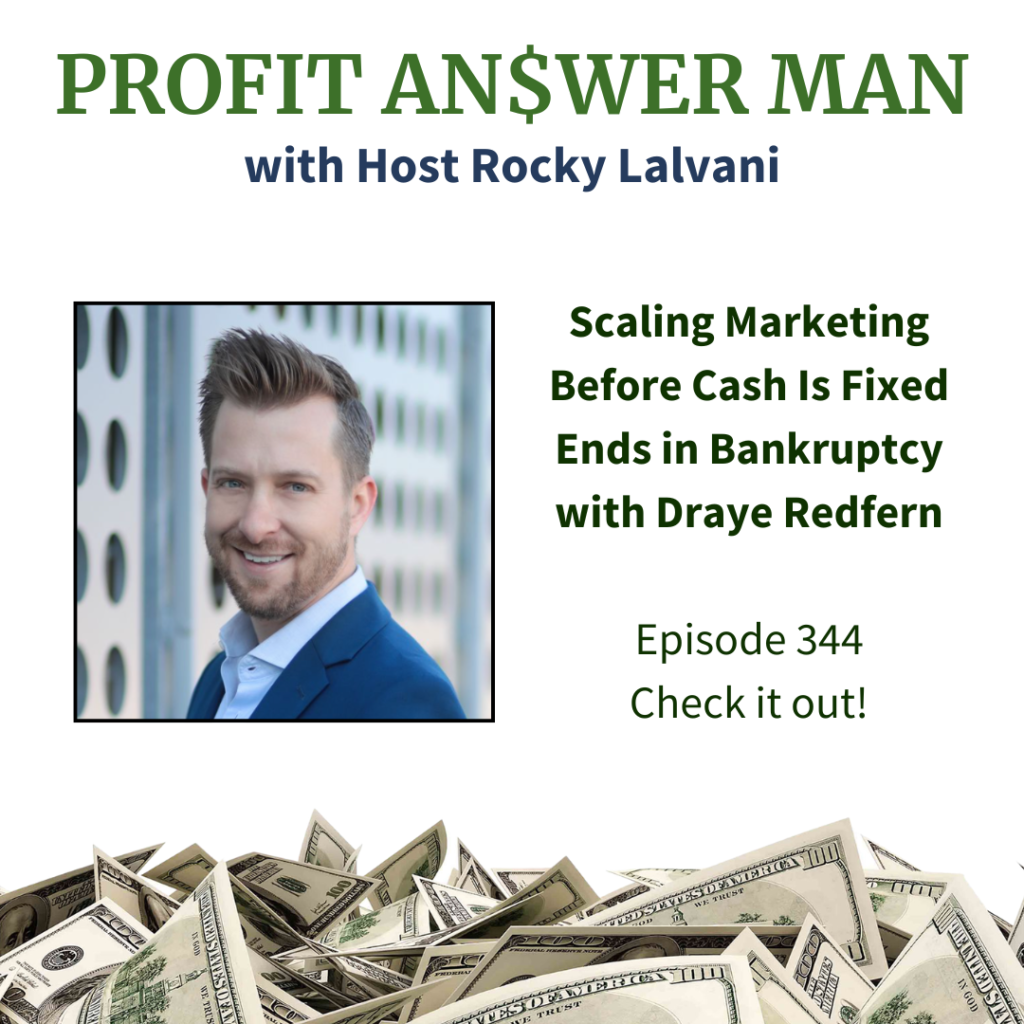
Episode 344 | The Profit Answer Man | Draye Redfern
You had a good quarter. Maybe your best quarter. Leads came in strong, the ad spend was finally working, the calendar was full. And somewhere around week three, you looked at the bank account and felt the exact same tightness you felt during the bad quarters. Nobody warned you that a good quarter could feel this way. That’s not bad luck. That’s a structure problem wearing the costume of a growth problem, and it’s the one hiding underneath this week’s episode with marketing expert Draye Redfern.
The Problem
Draye Redfern has spent 14 years running a marketing and advertising agency and the last five building FractionalCMO.com, giving businesses doing $500K to $15M in revenue access to senior marketing strategy without the cost of a full time hire. In his words, most businesses have what he calls “lever crankers.” People who can turn the knob. Run the ads. Post the content. Send the emails. What they don’t have is someone who knows which knob to turn, when, and in what order. The result, Draye says, is marketing that’s either feast or famine, or a slow drift down and to the right instead of up. He described it plainly: a business doing a million or three million dollars a year can’t justify a quarter million dollar marketing hire, so it ends up with someone capable of execution and nobody capable of strategy.
Here’s the part that turns a marketing conversation into a cash flow conversation. Rocky’s system runs on 16 levers, and the first few sit inside marketing: lead flow, conversion rate, retention. But as Rocky put it directly to Draye, that’s not always the lever a business needs cranked first. If gross profit is thin, or if cash isn’t timed right relative to expenses, pouring money into the marketing tank to move faster doesn’t fix anything. It accelerates the business toward the wall it’s already driving at. You grow yourself to bankruptcy, fast, and it can happen inside what looks on paper like your best year yet.
The Wrong Path
None of this happened because anyone got lazy or reckless. Every advisor, every growth podcast, every marketing agency pitch says the same thing: more leads, more customers, more revenue, problem solved. It’s not wrong advice in isolation. It’s incomplete advice, because it assumes the plumbing underneath the business, the gross margin, the cash conversion timing, is already sound. For a lot of $5M to $10M businesses, it isn’t.
There’s a second version of the wrong path Draye pointed to directly, and it’s more recent. When ChatGPT launched, a wave of business owners decided they no longer needed their marketing agency. The tools were free or cheap, the content came out fast, and it felt like the whole function had been solved overnight. Agencies across the industry got hammered, losing real client business in that first year or two, because owners genuinely believed they could do it themselves now. What happened next is the part Draye is watching play out currently: those same owners are quietly coming back, saying some version of “we tried this, it didn’t go as well as we thought, can you help us again.” The tools gave them output. They never gave them judgment. So the owner does exactly what every book and every consultant and every AI tool told them to do, spends real time and money doing it, and watches the results underdeliver or the cash position get worse instead of better. That’s not a marketing failure. It’s a sequencing and judgment failure, and almost nobody warns owners about either one before they write the check.
The Lever You Pull First Isn’t the Lever You Think
The instinct when growth stalls is to go get more customers. It feels like the obvious fix, and it’s the lever every marketing agency, and now every AI tool, is built to pull. But if gross profit or cash timing is broken underneath that growth, more customers means more of the same problem, just bigger and faster. Draye’s own framing of “lever crankers” describes exactly why this happens inside most businesses. The person running marketing knows how to execute. They were never handed a map of which lever actually moves the needle for this specific business, in this specific order. Fix cash timing and gross margin first, and the marketing spend that follows actually compounds instead of leaking straight back out the bottom. Skip that step, and every dollar of new revenue arrives with a matching dollar of new stress attached to it.
Your Website Might Already Be Invisible
Draye’s second warning is more immediate, and it has nothing to do with ad spend. As buyers increasingly ask ChatGPT, Claude, or Perplexity for the best option in their area instead of typing a search into Google, a business’s visibility now depends on whether those tools can actually read its website at all. Two fixes matter most right now. The first is schema markup, which structures the data behind your site so an AI tool can find the answer without guessing. Draye’s phrase for this: AI models are inherently lazy, and the business that hands them the answer on a silver platter is the business that gets recommended. The second is an llms.txt file alongside a standard robots.txt file, both of which tell AI crawlers what’s actually on your site and let them read it efficiently.
There’s a third layer worth knowing about even if it’s more advanced: hard-coding frequently asked questions directly into a site’s schema, in the code behind the page rather than the text a visitor sees. Done well, Draye says, it starts making one plus one equal eleven for how an AI tool understands and recommends a business.
Here’s the part most owners have never checked, and it’s the one that should genuinely concern you. Cloudflare’s default security setting, as of roughly the last six to eight months, blocks AI crawlers automatically. A site an owner believes is simply “secure” may be completely unreadable to the exact tools their next customer is using to find them, and there’s no error message telling them so. The fix is a single toggle. Most owners don’t know it exists.
AI Slop Is Real, and It’s Making Owners Skeptical of Everyone, Including You
Draye estimates that three to four out of every ten ads a person scrolls past on Facebook or Meta right now use AI generated content in some form, and possibly more. That volume is doing real damage to buyer trust, and it’s not isolated to ads. When creators simply repeat back whatever ChatGPT or Claude generated on camera, audiences can feel the sameness even when they can’t name what’s off about it. It’s also raising real doubt about the authenticity of reviews and testimonials people rely on to make decisions.
Draye’s read on where this goes next: live content, podcasts, webinars, in person events, is becoming the differentiator precisely because it’s harder to fake. He pointed to a client doing roughly $480M to $500M a year in revenue whose live webinar held viewer attention through a pitch delivered 52 minutes in, with average drop off not occurring until the 62 minute mark, across tens of thousands of viewers watching the same webinar run for weeks on end. People aren’t tuning out live content. They’re starving for it, because so much of what surrounds it is synthetic, and something imperfect and real reads as trustworthy in a way a polished, flawless video no longer does.
Don’t Build Your Business on Someone Else’s Platform
The AI tool landscape shifts every few months, and Draye was blunt about the risk of building critical infrastructure on top of any single one of them. He pays roughly $600 a month across Perplexity, ChatGPT, and Claude specifically so he isn’t dependent on whichever one happens to be winning this quarter, comparing it to a horse race where the leader changes every few months. He also flagged the cost side directly and personally: his own agency ran up $6,000 to $8,000 in ChatGPT charges in a single week with nobody watching the meter, a modern version of the same trap that turned a one cent Google AdWords click into a $100 click over twenty years. If you’re building automations, agents, or workflows on top of any single AI platform right now, ask what happens to that investment if the platform becomes obsolete or drastically changes pricing in twelve months. Build so a shift like that doesn’t take your operation down with it.
Rocky’s Perspective
Here’s what I see when a marketing conversation walks into my world. Somebody is doing everything right on paper: leads are up, the agency is delivering, the content calendar is full. And the owner is more stressed than when they started, because nobody ever checked whether the business could actually absorb that growth. You don’t need less marketing. You need to know if your gross profit can carry the weight of more customers, and whether your cash is timed to survive the gap between spending on growth and collecting the return on it. That’s not a marketing question. It’s a sequencing question, and it’s the one I ask before anyone talks to me about lead generation. A great fractional CMO like Draye can hand you the right marketing lever. Only you can tell him whether your business is actually built to absorb what happens when you pull it.
The One Thing
Before you increase marketing spend this quarter, get a straight answer on two numbers: your true gross profit margin, and how many days typically pass between when you spend on a customer and when you collect from them. If nobody in your business can answer both of those with a real number today, that’s the fix that comes before the next ad campaign, not after it. You’ll know, specifically, whether growth is about to help you or hurt you, instead of finding out the hard way three months into a marketing plan that’s already spending faster than it’s collecting.
You had a good quarter, and it still felt tight. That’s not a signal to spend more on marketing. It’s a signal to check the plumbing first. Once that’s sound, the growth you’re chasing finally shows up where you can actually feel it, in the bank account, not just the lead count.
About Draye Redfern
Draye Redfern is a leading authority in direct-response marketing with a proven track record of business success, including two successful company exits — one of which was acquired by a Berkshire Hathaway company owned by Warren Buffett. Known for driving exceptional results, Draye’s client roster spans Sharks from ABC’s Shark Tank, New York Times bestselling authors including Robin Sharma, Chris Voss, and Dr. Benjamin Hardy, and publicly traded companies — with over 1,500 engagements across businesses ranging from mom-and-pop shops to Wall Street firms.
As the founder of FractionalCMO.com, Draye offers strategic marketing leadership that helps businesses achieve sustainable growth without the commitment of a full-time executive hire. This approach provides growing companies with expert-level guidance precisely when needed, enabling efficient scaling and strategic development.
Draye is also the founder of Redfern Media, a marketing and consulting agency that transforms traditional marketing efforts into client-focused strategies through systematized, automated, and streamlined processes — enhancing engagement, improving conversions, and turning satisfied customers into passionate “Raving Fans.”
Links
Websites: https://fractionalcmo.com
LinkedIn: https://www.linkedin.com/in/drayeredfern/
Facebook: https://www.facebook.com/DrayeRedfern/
Instagram: https://www.instagram.com/drayeredfern/
Profit Blueprint Calculator I Profit Comes First: https://lp.profitcomesfirst.com/profitblueprintcalc-page
Watch the full episode on YouTube: https://www.youtube.com/@profitanswerman
Sign up to be notified when the next cohort of the Profit First Experience Course is available!
Free Copy of the Profit Blueprint Book: https://lp.profitcomesfirst.com/landing-page-page
Monthly Newsletter signup: https://lp.profitcomesfirst.com/newsletter-signup
Relay Bank (affiliate link): https://relayfi.com/?referralcode=profitcomesfirst
Profit Answer Man Facebook group: https://www.facebook.com/groups/profitanswerman/
My podcast about living a richer more meaningful life: http://richersoul.com/
Music provided by Junan from Junan Podcast
Any financial advice is for educational purposes only and you should consult with an expert for your specific needs.