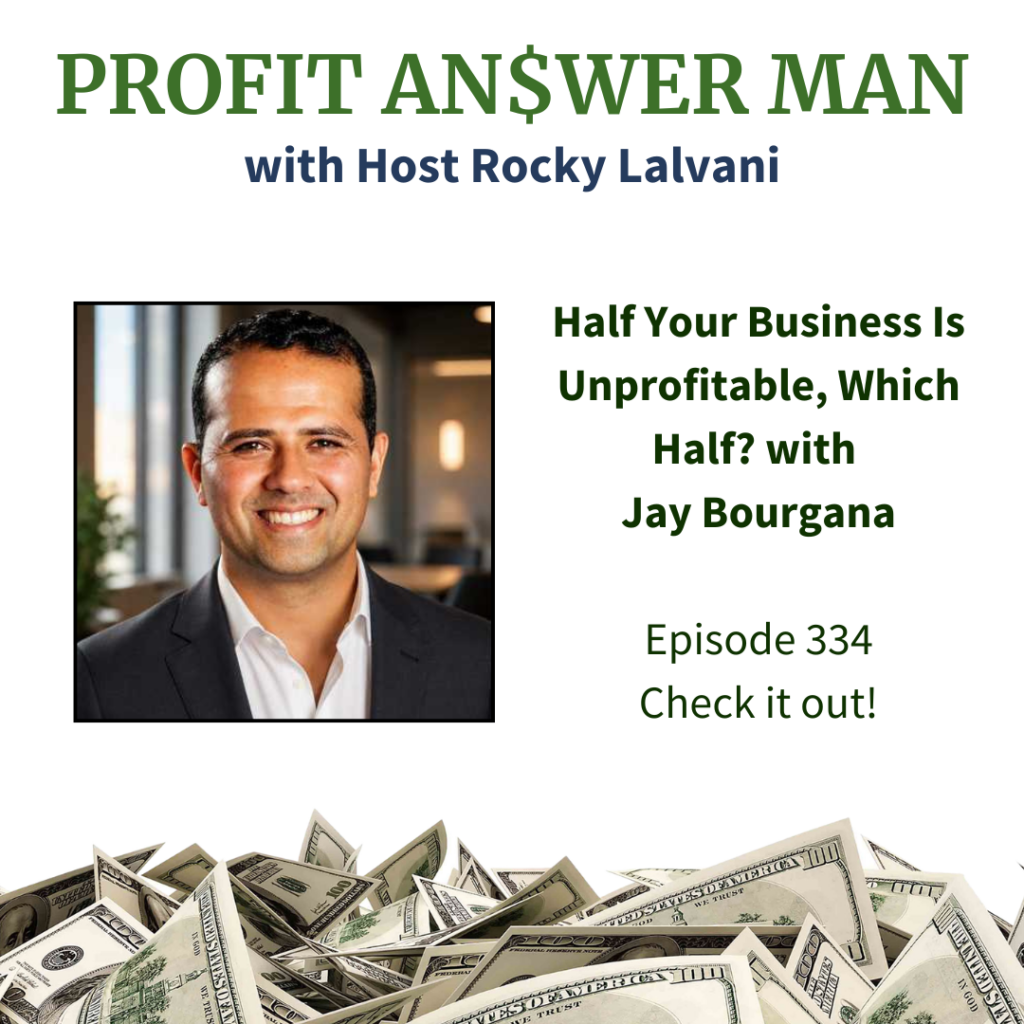
Episode 334 | The Profit Answer Man I Jay Bourgana
Your revenue is up this year. On paper, it was a good year. And somehow you’re still moving money around two days before payroll, still wondering where it all went, still telling yourself that next quarter will feel less tight. You’ve checked the P&L. The number at the bottom looks fine. So why does it not feel fine?
The Problem: You’re Measuring the Wrong Half
Jay Bourgana has spent his career inside businesses doing $10M to $150M, first as an operator building and exiting companies, then as an advisor cleaning up the data behind them. When Rocky asked him what percentage of a typical company’s activity turns out to be unprofitable once you actually look, his answer was immediate: roughly 50%. Not 50% of revenue lost. Fifty percent of what the business does, day in and day out, quietly loses money. And the owner almost never knows which half.
That’s not a vague inefficiency. It’s a specific, checkable gap sitting inside your P&L right now, hidden by the fact that most owners only track their numbers in aggregate. You know your total revenue. You know your average margin. You do not know your churn rate on a specific client type, your true cost to acquire a specific product category, or which service line is actually funding the other four. Jay put it plainly: you can go into the numbers and know them in aggregate, know them in averages, but not really know them.
The Wrong Path: Why You Ended Up Here
Of course you built it this way. Nobody handed you a client-by-client profitability report on day one. You were surviving. You landed clients, delivered the work, made payroll, and the business grew because you were good at sales and good at delivery. Every advisor, every growth playbook, every “just add revenue” conversation told you that more top-line was the answer. It wasn’t wrong. It was incomplete. Growth without visibility just means you’re scaling the unprofitable half right alongside the profitable one, faster than before.
Jay described this as a form of survival bias. You made it through the hard early years, the business is profitable enough, decent enough, and it’s working, so why mess with it. That confidence is earned. It’s also exactly what keeps owners from rebuilding the foundation once the business has outgrown the systems that got it here. He compared it to the difference between running a pirate ship and running a Navy. Going back to fix the structure feels like undoing hard-won progress, so most owners don’t.
The Insights: What Jay Sees That Most Owners Miss
You’re Managing With the Lights Off
Jay’s metaphor for most companies he walks into: someone has a wound somewhere and they’re bleeding and blind at the same time. They know something is off. They don’t know where, or why. His first move with a new client isn’t a fix. It’s turning on the lights, cleaning up the systems, and building a real picture of what’s happening before touching anything. He typically asks for 90 days just to show an owner what clean data looks like. The fix comes after. The visibility comes first.
Your Accounting System Is Already Too Late
Rocky and Jay agree on this even though they frame it differently. Rocky watches sales data and operational data as the leading and mid-cycle indicators, because the accounting system is confirming what already happened 60 to 90 days ago. If you wait for the P&L to tell you something is wrong, you’re finding out about a decision you made three months ago, with no ability to change course today. The businesses that stay ahead of a downturn are the ones watching the earlier signals, not the lagging ones.
Hiring Is a Scouting Problem, Not a Posting Problem
Most companies hire reactively. A role opens, a job description goes out, five resumes come in, one gets picked. Jay’s approach is closer to professional sports scouting: identify your top performers in a role, build a data-backed profile of what they have in common, and recruit continuously against that profile, whether or not you have an open seat right now. Waiting until you’re desperate means competing for talent that’s already employed, against someone else who never stopped scouting.
Being the Best Salesperson in Your Company Is Costing You
This one stings a little. Jay pointed out that a lot of great salespeople make terrible sales managers, and when the owner is also the top producer, the business develops a concentration risk that quietly caps its value. If the business can’t function without you closing the biggest deals, it isn’t really a business yet. It’s a job with better margins. That gap between “profitable” and “sellable” is exactly where a lot of owner enterprise value disappears.
Rocky’s Perspective
Here’s what I see when I sit down with a $7M business and ask for their numbers by client type instead of in aggregate: silence, followed by “we’ve never broken it out that way.” Every owner I’ve worked with believed they knew their numbers. Almost none of them actually did, not at the level that matters. Your bookkeeper records the past. Your CPA files the past. Nobody sits down and reads the story your numbers are telling before prescribing a fix. That’s the step most advisors skip, and it’s the one I refuse to.
Everyone needs a scoreboard. I’m constantly amazed at how many business owners are playing the game and don’t know the score. Then they wonder why there’s no money in the bank at the end of a record year. The money isn’t missing. It’s sitting inside the half of the business nobody’s looked at yet.
The One Thing
This week, pull your numbers by client type or product line, not in aggregate. Just one cut. If you sell more than one type of service or work with more than one kind of client, separate the margin on each. You are looking for the gap Jay described: the piece of your business that’s quietly losing money while the rest of the P&L makes it look fine. You will know within one spreadsheet whether you’re in the “known which half” group or the “still guessing” group.
Conclusion
You didn’t build an unprofitable business on purpose. You built a business that survived, grew, and worked well enough that nobody ever had a reason to go back and check the seams. That’s not a failure. It’s just a company that’s outgrown the visibility it started with. The fix isn’t more revenue. It’s turning the lights on.
About Jay Bourgana
Jay Bourgana is an operator, investor, and founder of Acquisition Collective, where he helps entrepreneurs buy and scale cash-flowing businesses. After years building, operating, and acquiring companies across multiple industries, Jay now teaches first-time buyers how to source deals, evaluate risk, negotiate with sellers, and think like real operators, not spectators.
Links
Website: https://acquisitionscollective.biz/
LinkedIn: https://www.linkedin.com/in/jay-bourgana/
Facebook: https://www.facebook.com/jay.bourgana
Instagram: https://www.instagram.com/jay_bourgana
YouTube: https://www.youtube.com/@AcquisitionCollective
TikTok: https://www.tiktok.com/@acquisitioncollective
Profit Blueprint Calculator I Profit Comes First: https://lp.profitcomesfirst.com/profitblueprintcalc-page
Watch the full episode on YouTube: https://www.youtube.com/@profitanswerman
Sign up to be notified when the next cohort of the Profit First Experience Course is available!
Free Copy of the Profit Blueprint Book: https://lp.profitcomesfirst.com/landing-page-page
Monthly Newsletter signup: https://lp.profitcomesfirst.com/newsletter-signup
Relay Bank (affiliate link): https://relayfi.com/?referralcode=profitcomesfirst
Profit Answer Man Facebook group: https://www.facebook.com/groups/profitanswerman/
My podcast about living a richer more meaningful life: http://richersoul.com/
Music provided by Junan from Junan Podcast
Any financial advice is for educational purposes only and you should consult with an expert for your specific needs.