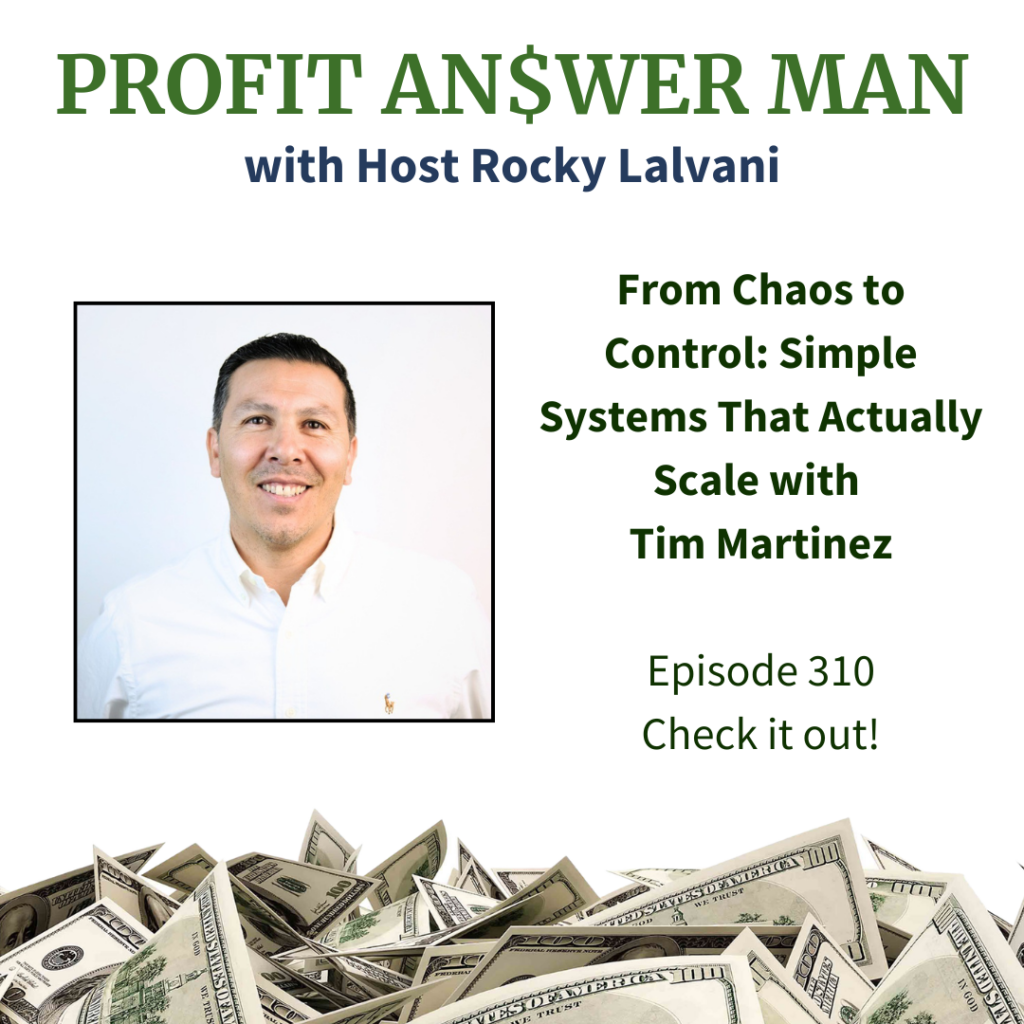
Episode 310 | The Profit Answer Man I Featuring Tim Martinez
If you’ve ever felt like your business is “successful”… but also exhausting, reactive, and overly dependent on you, you’re not alone. Many founders and CEOs hit a stage where growth doesn’t feel like freedom; it feels like more complexity, more fires, and more decisions that only one person can make.
In this episode, Rocky Lalvani sits down with Tim Martinez, a seasoned business operator and advisor, to unpack what it really takes to scale without spinning into chaos. The core theme is simple: scalable companies aren’t built on hustle. They’re built on systems.
Tim brings a rare blend of perspective: he’s spent more than two decades advising leadership teams across industries, and he’s also owned, operated, invested in, and exited multiple businesses. That combination makes the conversation practical and immediately useful, especially if you’re trying to break through a plateau, tighten profitability, or prepare for a future exit.
What You’ll Learn in This Episode (Quick Summary)
If you’re short on time, here are the big ideas covered:
You’ll learn why many businesses stall at what Tim calls the “$3 million wall,” why owners often resist “working on the business,” and how that resistance is frequently tied to control, fear, and ego.
You’ll also hear why frameworks like Profit First and Traction (EOS) work best when you adapt them instead of forcing your business to follow them perfectly.
Finally, Tim gets into practical scaling fundamentals: SOPs, accountability, leadership bench strength, cash reserves (“war chest”), smart investment vs. vanity spending, and time as a measurable currency.
The “$3 Million Wall”: Why So Many Businesses Get Stuck
One of the most memorable moments in the conversation is Tim’s observation that a huge number of small businesses plateau around the $3 million range. Not because the owner isn’t smart. Not because the product is bad.
But because that stage forces a decision:
Do you want a business that stays manageable through your personal control… or a business that grows through systems and delegation?
Tim notes that many owners say they want growth, but at a deeper level they may be comfortable with what he calls “manageable chaos.” That chaos can feel like control, because everything routes back to the owner. But it also creates a ceiling on revenue, profit, and freedom.
If you’re hovering at a plateau (whether it’s $1M, $3M, or $10M), the key question isn’t “How do I work harder?” It’s:
What must become true, operationally and leadership-wise, for this business to grow without me being the bottleneck?
Profit First, Traction (EOS), and the Right Way to Use Frameworks
Tim and Rocky discuss two well-known business operating frameworks:
- Profit First (cash management through intentional allocations)
- Traction / EOS (operating rhythm, accountability, and execution)
What stands out is Tim’s stance: don’t treat frameworks like religion. Use them as tools.
That approach is surprisingly liberating for founders who struggle with implementation. If you’ve ever started a system and abandoned it, the answer might not be “try harder.” It might be “adapt it until it fits your business reality.”
A scalable system is one your team can actually follow consistently. A perfect system nobody uses is just a document.
Simplicity Is the Ultimate Sophistication (and Why Owners Resist It)
A recurring tension in business: owners often claim they want simple solutions, but emotionally they sometimes trust complexity more.
Rocky points out something many Profit First practitioners see: you can offer a simple structure (a few “buckets” for cash), and people still resist because it feels “too easy” to be real.
Tim’s take is blunt and useful: some people will always prefer complexity, and sometimes the best move is to avoid trying to convert them. The best clients are the ones who are ready to simplify, systemize, and execute.
If you’re trying to scale, simplicity isn’t the beginner version of business—it’s the advanced version.
The Hidden Growth Killer: Ego (and Holding On Too Long)
Tim highlights a tough truth: entrepreneurs often hold onto losing bets longer than they should.
It might be:
- an outdated service line
- a market that has moved on
- a business model that worked “seven years ago”
- a product that’s past its lifecycle
- a key employee who used to be a fit, but no longer is
Why do owners hold on? Tim names the culprit: ego, and the need to be right.
A scalable company requires the willingness to ask, “Is this still working?” and to pivot before the business forces your hand.
“Vanity Investments” vs. Real Investments
One of the most practical segments is the distinction between reinvesting for growth and simply spending money in ways that feel good.
Rocky gives common examples:
- the fancy truck in the trades
- upgraded office equipment with no ROI
- marketing spend without a strategy (money burned, not invested)
Tim agrees and expands the idea: bigger companies budget for R&D because they understand product lifecycles. Small businesses have lifecycles too, they just pretend they don’t.
Real reinvestment often looks like:
- systems that reduce labor cost per unit of output
- technology that removes bottlenecks
- leadership development (not just owner development)
- improving delivery capacity and client experience
- building repeatable processes that reduce error and rework
Build a War Chest: Why Cash Reserves Create Options
When Rocky asks about building a war chest, Tim gives a practical benchmark: 3 to 6 months of operating expenses as a strong best practice.
Why does that matter?
Because cash reserves create optionality. They allow you to:
- survive downturns without desperation decisions
- invest in growth at the right time
- make strategic hires (instead of rushed hires)
- move on acquisitions faster when opportunities arise
- avoid “profitless growth” fueled by stress and debt
In other words, reserves aren’t just safety, they’re strategic leverage.
A-Players Don’t Want to Work with C-Players
Tim gets into a leadership truth that many owners avoid: talent quality is contagious.
High performers want to work with other high performers. If your organization tolerates low standards, lateness, sloppy work, bad attitudes, poor follow-through, your best people will feel it first.
And over time, they either disengage… or leave.
Tim’s point is especially relevant for owners who want to scale: the team that got you “here” may not be the team that gets you “there.” If your next stage requires stronger leadership, you must build the bench intentionally.
That’s not cold. It’s responsible—especially if you’re thinking about exit planning, valuation, or succession.
The Fish Stinks from the Head: Culture Starts at the Top
When Rocky asks what Tim sees repeatedly across businesses, Tim goes straight to the top:
“The fish stinks from the head.”
It’s a reminder that most business problems aren’t “technical.” They’re human:
- avoidance
- unclear expectations
- weak accountability
- tolerating underperformance
- unclear priorities
- inconsistent leadership behavior
Tim defines culture simply as “what we allow.” That’s a powerful reframe for owners who think culture is a poster on the wall.
If you want to change culture, you don’t start with slogans. You start with what you tolerate and what you enforce.
Time Is Currency: The Unforgivable Sin Is Not Knowing
Late in the episode, Tim drops a line worth repeating:
The unforgivable sin is not knowing how much time something takes.
There’s no line item on the P&L for time, but time leaks show up everywhere:
- missed deadlines
- inconsistent client delivery
- too many meetings
- rework and errors
- poor scheduling/routing
- low utilization
- overwhelmed A-players doing cleanup work
Tim and Rocky discuss how meetings are a common offender: recurring meetings with no agenda, unclear outcomes, and no follow-through are expensive, even if they “feel normal.”
A scalable company measures time, protects it, and structures it.
Practical Takeaways: How to Move from Chaos to Control
If you want to apply this episode immediately, start here:
First, pick one area of chaos and systemize it. Not ten things, one. Create a simple SOP, reduce steps, and make it repeatable.
Second, clarify accountability. Every major initiative needs a single owner, deadlines, and follow-through. (Tim mentions structured responsibility frameworks that make this easier.)
Third, identify where profit is leaking: labor, time, customer concentration, or delivery inefficiency. Tiny lever pulls can create massive margin improvements, often without doubling work.
Fourth, invest in the team, not just the owner. Leadership development shouldn’t stop with the CEO.
And finally, build your war chest. Cash reserves reduce fear-driven decisions and increase strategic options.
Who Is Tim Martinez
Tim is a seasoned business operator and advisor with more than twenty years of experience helping founders, CEOs, and executive teams build companies that actually scale. His work spans operations, strategy, leadership, and growth, with hands-on experience across software, media, retail, gaming, and finance. Having owned, operated, invested in, and exited multiple businesses, Tim brings a practical, real-world perspective to building durable companies that create value for employees, customers, and communities.
Links
Website: https://www.theinsideman.biz/
LinkedIn: https://www.linkedin.com/in/theinsideman/
Substack: https://timtheinsideman.substack.com/
Share This Episode (Help Another Owner Break Through)
If you know an owner who’s stuck in constant firefighting, share this episode with them. A single text—“This is the systems episode you need”- can be the nudge that helps them stop spinning and start building.
If this episode resonated, listen all the way through. There are multiple moments where Tim reframes what “scaling” actually means: not just bigger revenue, but a more durable company that creates value for employees, customers, and communities.
Ep 310 From Chaos to Control: Simple Systems That Actually Scale with Tim Martinez: https://profitcomesfirst.com/ep-310-from-chaos-to-control-simple-systems-that-actually-scale-with-tim-martinez/
Watch the full episode on YouTube: https://www.youtube.com/@profitanswerman
Sign up to be notified when the next cohort of the Profit First Experience Course is available!
Free Copy of the Profit Blueprint Book: : https://lp.profitcomesfirst.com/landing-page-page
Monthly Newsletter signup: https://lp.profitcomesfirst.com/newsletter-signup
Relay Bank (affiliate link): https://relayfi.com/?referralcode=profitcomesfirst
Profit Answer Man Facebook group: https://www.facebook.com/groups/profitanswerman/
My podcast about living a richer more meaningful life: http://richersoul.com/
Music provided by Junan from Junan Podcast
Any financial advice is for educational purposes only and you should consult with an expert for your specific needs.