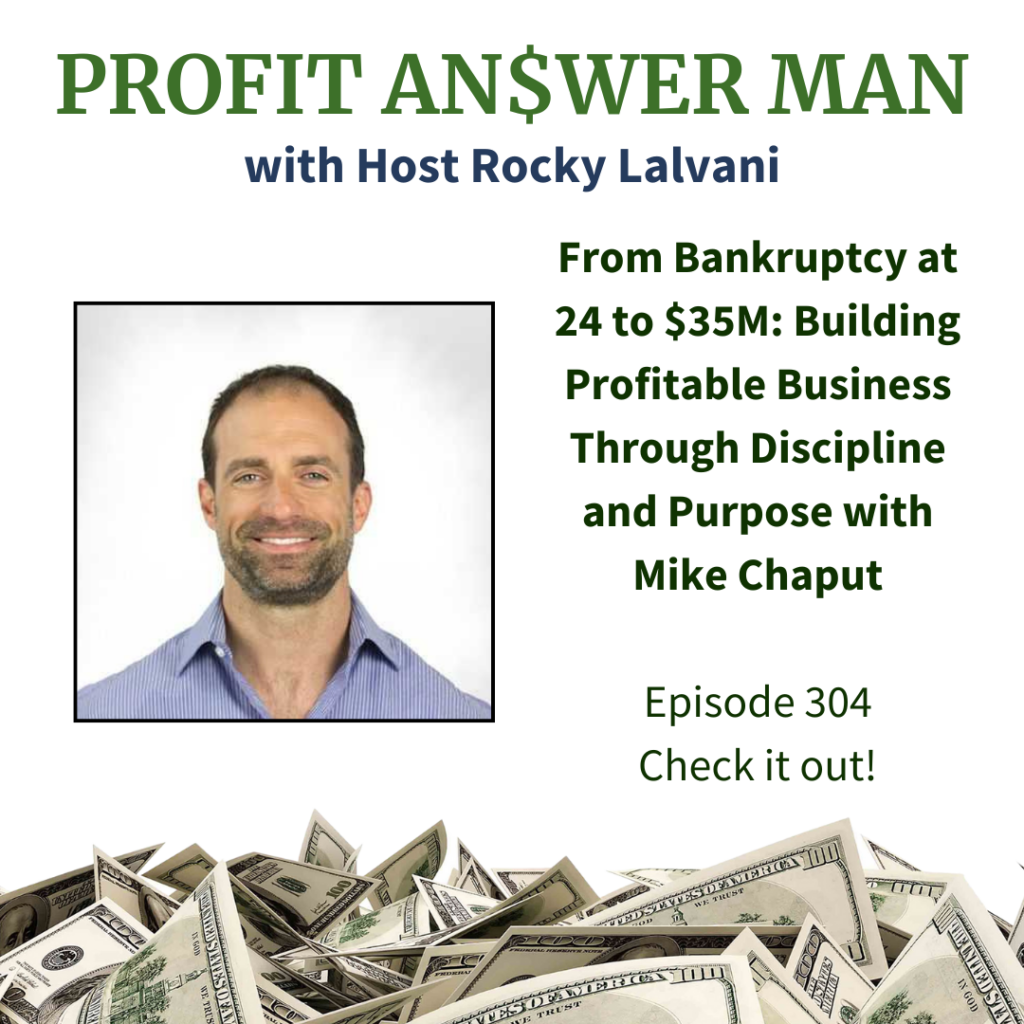
Episode 304 | The Profit Answer Man
Imagine being 24 years old. You have just bought a business. You are excited, ambitious, and ready to conquer the world. There is just one problem: you don’t know how to read a balance sheet, you have never led a team, and the market you just bought into—networking equipment—is about to crash along with the dot-com bubble.
This was the reality for Michael Chaput. He spent four and a half years fighting to keep that business alive before it ultimately went bankrupt in 2004.
Most people would have walked away from entrepreneurship forever. Michael didn’t. Instead, he took those hard-earned lessons and founded Ensight, an IT managed service provider based in California. Today, Ensight has grown to 150 employees generating approximately $35 million in revenue.
But the most impressive statistic isn’t the revenue. It is the consistency.
26 YEARSWithout a Single Red Month
In this episode of The Profit Answer Man, Michael shares how he transformed from a bankrupt young man into a disciplined CEO, his unique philosophy on motivation, and why profit should be viewed as a constraint rather than a purpose.
The Expensive Tuition of Bankruptcy
Michael describes his first venture as a masterclass in what not to do. At 24, he was so eager to become an entrepreneur that he ignored the red flags during due diligence.
“We really wanted this deal to happen,” Michael recalls. “And because we wanted it to happen so badly, we didn’t qualify it out. So we ended up in a bad deal.”
They signed a lease for too much space at too high a cost. They took on debt they couldn’t service. For over four years, they lived hand-to-mouth until a software development team walked out, sealing the company’s fate.
Key Lessons from Failure:
- Negotiate relentlessly: Bad deals (like expensive leases) sustain for long durations and drain cash flow.
- Trust but verify: Michael learned the hard way that not everyone is a “good actor.” Relying solely on verbal agreements without protection can be fatal.
- Financial literacy is non-negotiable: You cannot run a business if you don’t understand the relationship between the P&L and the Balance Sheet.
The Discipline of 26 Years in the Black
When Michael and his partner started Ensight, they vowed never to repeat the past. They joined a peer group, reconstituted their general ledger to match industry standards, and obsessively tracked expense ratios.
While many business owners treat their financials with avoidance, Michael treats them as a scorecard. The result is a company that has been profitable every single month for over two decades—through the 2008 financial crisis and the COVID-19 pandemic.
“People say, ‘Knock on wood.’ It’s not a knock-on-wood thing. It’s a discipline. It’s not luck or chance. It’s decisions. It’s a constraint, and we play our business game inside of that constraint.”
Ensight targets a 17% net margin. If they start drifting from that target, they don’t hope things get better; they make immediate decisions to get back in alignment.
The Trap of “Nice” Leadership
One of the most profound insights from this episode is Michael’s take on managing poor performers. He argues that many leaders avoid firing people because they tell themselves a story: “I’m a good person. This employee has a family. I don’t want to hurt them.”
Michael challenges this narrative. He believes that keeping a poor performer in a job where they are struggling is actually cruel. It keeps them in a state of “economic pressure” and prevents them from finding work where they can truly thrive.
“You’re not going to invoke the spirit of play in anybody in that scenario,” Michael explains. “All you’re doing is keeping that family member in a job… inhibiting their growth as a human from doing greater, better things.”
The Science of Motivation: Play vs. Pressure
Michael is a voracious learner, having read over 1,000 books in the last 20 years. One book that heavily influenced his management style is Primed to Perform by Doshi and McGregor.
The framework identifies six sources of motivation. Three lead to high performance, and three lead to low performance.
High-Performance Motivators:
- Play: You do the work because you enjoy the work itself.
- Purpose: You value the outcome of the work.
- Potential: The work leads to a personal goal (e.g., a clerk working to become a lawyer).
Low-Performance Motivators:
- Economic Pressure: You work solely to pay bills.
- Emotional Pressure: You work to avoid disappointment or shame.
- Inertia: You work because you did it yesterday.
To illustrate “Play,” Michael uses a brilliant analogy involving the video game Minecraft. When he first played with his sons, it was boring. They were just wandering around. But once they decided to build a castle tower, the game became addictive. They had a shared goal. They had obstacles to overcome. It became fun.
The Takeaway: If you want high-performing employees, you need to give them a “tower to build.” You need a vision that inspires the spirit of play.
Profit is a Constraint, Not a Purpose
This might sound contradictory coming from a man who runs a highly profitable company, but Michael does not believe the purpose of a business is to make a profit.
“I look at it as a constraint,” he says. “Businesses must make profit because that’s the game. It’s not the purpose of a basketball team to stay in bounds… but if you don’t stay in bounds, you can’t play the game.”
A CEO’s job is to balance the “three-legged stool” of the organization:
- Employees: Must get enough economically and emotionally to keep showing up.
- Customers: Must get enough value to keep buying.
- Shareholders: Must get a return on capital (risk), otherwise they should invest elsewhere.
If you prioritize one leg over the others—for example, sacrificing profit to keep a poor-performing family member employed—the stool collapses.
Installing the Operating System
How do you execute all of this? You need an operating system. Michael referenced “Rockefeller Habits” (the precursor to Scaling Up) as the tool that saved his second business. Whether you use EOS (Traction), Scaling Up, or another system, the requirement is the same: you need a blueprint.
You cannot build a house by just telling a crew, “Build me a house.” You need electrical plans, plumbing plans, and structural plans. Similarly, a business needs a vision, a sales plan, and an operating plan. Without these blueprints, your team is just wandering around in Minecraft without a tower to build.
Key Takeaways for Business Owners
- Face the Numbers: You cannot improve what you do not measure. Join a peer group to benchmark your expenses against the industry.
- Define Your “Tower”: Create a clear, shared vision to move your team from “economic pressure” to “play” and “purpose.”
- Hold the Line on Profit: Treat your profit margin (e.g., 17%) as a non-negotiable constraint, not a leftover result.
- Fire with Compassion: Keeping a poor performer hurts the company and prevents the employee from finding their true potential.
- Install an OS: Use a system like EOS or Rockefeller Habits to give your team the blueprints they need to succeed.
Bio:
Mike Chaput bought his first company at 24 with borrowed money and no experience, a move that led to early failure and bankruptcy, but also ignited a lifelong drive to understand what makes businesses succeed. He took those hard-won lessons and built a new company from the ground up, scaling it to $35M in revenue with 140 employees, best-in-class margins, and a values-driven culture. With degrees from Columbia Business School and UC Berkeley’s Haas School of Business, Mike blends top-tier strategy with real-world execution. As a founder and the CEO of Endsight, as well as a board member and trusted advisor to multiple high-growth companies, Mike brings a grounded, operator’s perspective to leadership, sustainable growth, and building resilient teams with purpose.
Links:
Website: https://www.endsight.net/
LinkedIn: https://www.linkedin.com/in/michaelchaput/
Instagram: https://www.instagram.com/thechaputperspective/
YouTube: https://www.youtube.com/@thechaputperspective
Ready to build your tower?
Listen to the full conversation with Michael Chaput in Episode 304 of The Profit Answer Man to hear the deeper details of his journey from bankruptcy to $35M: https://profitcomesfirst.com/ep-304-from-bankruptcy-at-24-to-35m-building-profitable-business-through-discipline-and-purpose-with-mike-chaput/
Watch the full episode on YouTube: https://www.youtube.com/@profitanswerman
Sign up to be notified when the next cohort of the Profit First Experience Course is available!
Free Copy of the Profit Blueprint Book: : https://lp.profitcomesfirst.com/landing-page-page
Monthly Newsletter signup: https://lp.profitcomesfirst.com/newsletter-signup
Relay Bank (affiliate link): https://relayfi.com/?referralcode=profitcomesfirst
Profit Answer Man Facebook group: https://www.facebook.com/groups/profitanswerman/
My podcast about living a richer more meaningful life: http://richersoul.com/
Music provided by Junan from Junan Podcast
Any financial advice is for educational purposes only and you should consult with an expert for your specific needs.